
Your Car's Maintenance Schedule, Explained

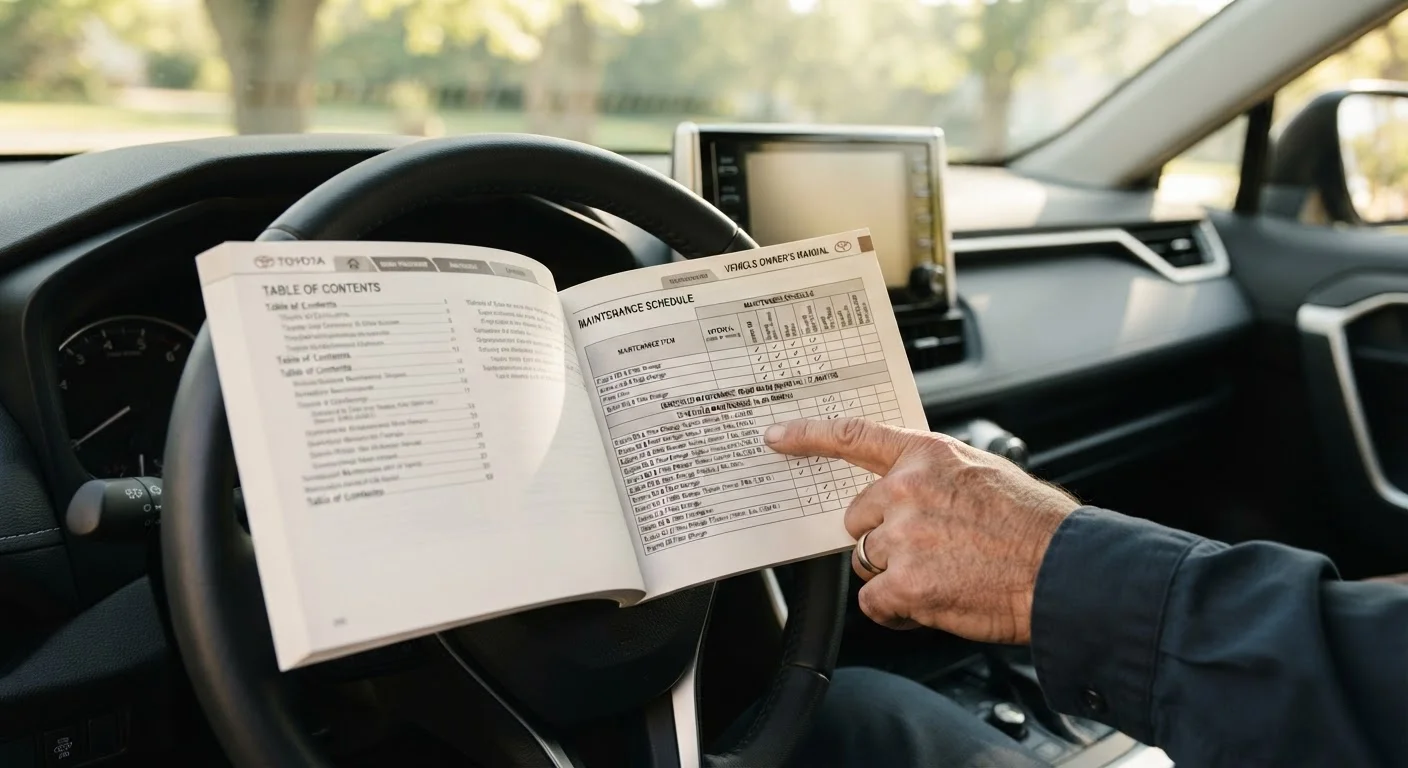
Photo: AdvisorBooth.net editorial
Key Takeaways
- Your owner's manual contains the most accurate maintenance schedule for your specific vehicle.
- Maintenance intervals are expressed in both mileage and time - whichever comes first applies.
- Driving conditions (city stop-and-go vs. highway) affect how quickly wear accumulates.
- Skipping scheduled maintenance can void warranties and lead to costly component failures.
- Not all maintenance items follow the same interval - some are monthly, others every 30,000 or 100,000 miles.
- Modern vehicles with oil life monitoring systems still require attention beyond just oil changes.
What a Maintenance Schedule Actually Is
Open any owner's manual and you'll find a chart listing services tied to specific mileage milestones - 5,000 miles, 15,000 miles, 30,000 miles, and beyond. This is your vehicle's maintenance schedule, and it represents the manufacturer's engineering guidance for keeping your car in sound mechanical condition. It isn't a suggestion - it's a road map developed through testing to match your specific engine, drivetrain, and component design.
Each line item on that chart represents a part or fluid with a predictable service life. When that life expires, wear accelerates, protection diminishes, or the risk of failure rises. Understanding the schedule at this level - not just memorizing intervals, but knowing why they exist - makes you a more empowered car owner.
For a deeper look at what's happening inside your engine between service visits, see what actually happens inside your engine between oil changes.
How Mileage and Time Intervals Work Together
Most maintenance items are expressed with two triggers: a mileage figure and a time period - for example, "every 7,500 miles or 12 months, whichever comes first." The dual trigger exists because both use and calendar time degrade vehicle components, sometimes independently.
A driver who commutes 15,000 miles per year will hit the mileage threshold before the time threshold. A driver who puts fewer than 7,500 miles on their car annually will reach the time limit first - even though the odometer barely moved. In the second scenario, the car isn't being neglected through overuse; it may actually experience more wear from short, frequent cold starts that never allow the engine to fully warm up.
~$80B
Annual cost of neglected vehicle maintenance in the U.S.
According to AAA research, U.S. drivers spend roughly $80 billion annually on vehicle repairs that could have been prevented or reduced through routine maintenance.
35%
Drivers who don't follow their maintenance schedule
AAA surveys have found that a significant share of American drivers are behind on at least one recommended maintenance service at any given time.
If your driving patterns fall into what manufacturers call severe conditions - frequent short trips, heavy traffic, towing, extreme temperatures, or dusty environments - your schedule may call for shorter intervals than the standard recommendations. Most owner's manuals include a separate "severe duty" schedule for exactly this reason.
The Key Milestones and What They Cover
Maintenance items aren't all on the same clock. Here's a general breakdown of what tends to come due at common intervals - though your specific vehicle may differ:
- Every 5,000-10,000 miles: Engine oil and oil filter replacement, tire rotation, visual inspection of brakes and lights.
- Every 15,000-30,000 miles: Air filter inspection or replacement, cabin air filter, brake fluid check, battery condition check.
- Every 30,000-60,000 miles: Transmission fluid, coolant flush, spark plugs (on many vehicles), drive belt inspection.
- Every 60,000-100,000 miles: Timing belt replacement (on interference engines), fuel system service, power steering fluid.
These are general benchmarks. Always cross-reference your owner's manual, as intervals vary meaningfully between manufacturers, engines, and model years. For a closer look at commonly overlooked items, see neglected maintenance items that mechanics see most often.
Keep a Simple Service Log
Why Staying on Schedule Protects More Than Just the Engine
Routine maintenance isn't only about engine longevity. Tires, brakes, steering, and fluid systems all have service lives tied to the same schedule. A skipped tire rotation leads to uneven wear that shortens tire life. Degraded brake fluid absorbs moisture and raises the risk of brake fade under heavy use. Old coolant loses its corrosion-inhibiting properties and can damage radiator and water pump components from the inside.
There's also a financial dimension. Many new-vehicle warranties contain language requiring documented, schedule-compliant maintenance. Skipping services - especially oil changes - can give manufacturers grounds to limit warranty coverage on related engine damage.
If you're managing an older or high-mileage vehicle, the calculus shifts somewhat. See keeping a high-mileage vehicle reliable for guidance specific to cars past 100,000 miles. And for drivers new to vehicle ownership, car maintenance for first-time owners is a solid starting point.
Tire health is its own maintenance category worth understanding fully - tire maintenance from the ground up covers pressure, tread, rotation, and replacement in plain terms.
Frequently Asked Questions
The content on this site is for informational purposes only and is not a substitute for professional advice. Always consult a qualified professional for guidance specific to your situation.