
Stocks, Bonds, and Cash: A Plain-Language Breakdown of Asset Classes

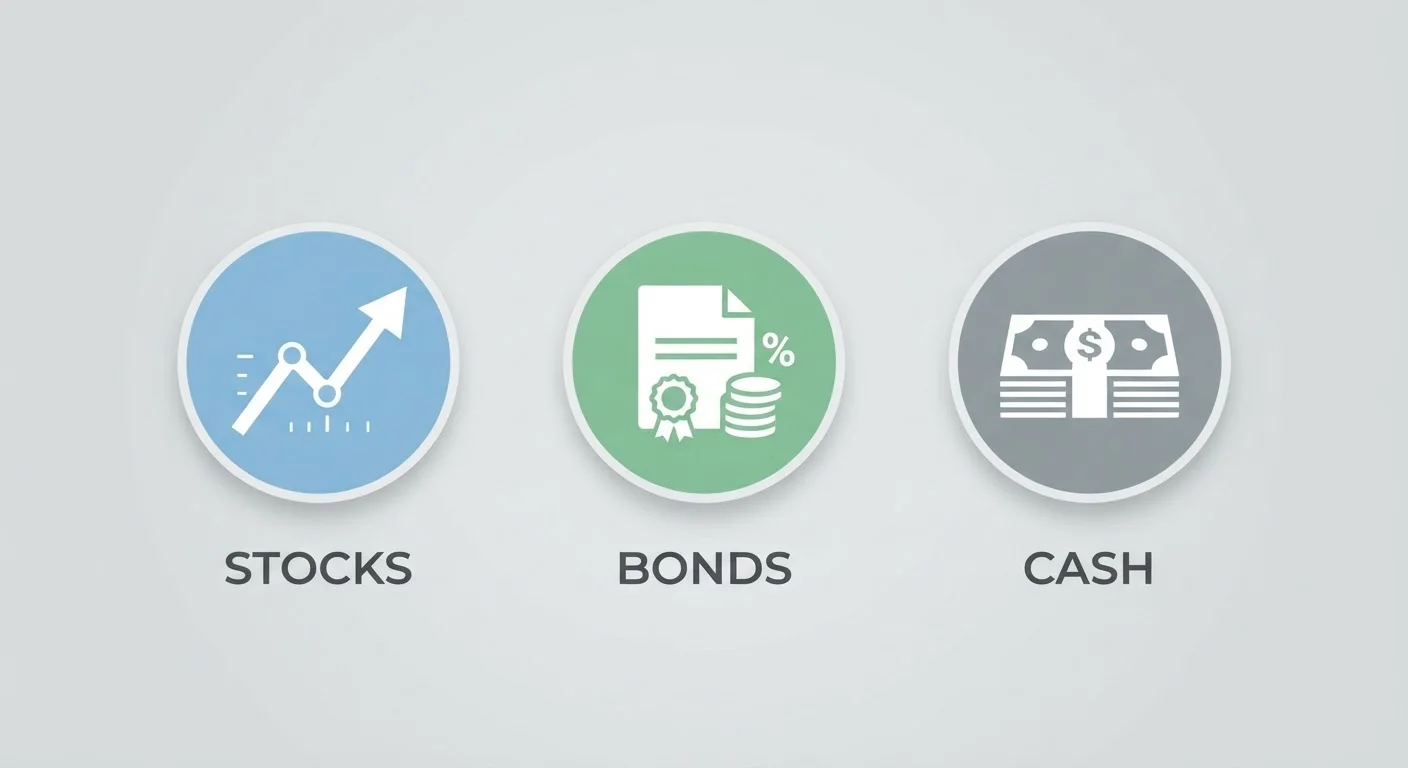
Photo: AdvisorBooth.net editorial
What Is an Asset Class?
An asset class is a category of investment that shares similar characteristics, behaves similarly in the market, and is governed by the same basic rules. Stocks, bonds, and cash equivalents are the three foundational asset classes - sometimes called the "building blocks" of any portfolio.
Why does this matter? Because different asset classes carry different levels of risk, generate income in different ways, and tend to respond differently to economic conditions. Spreading money across more than one asset class is the core idea behind diversification - a strategy meant to reduce the impact of any single bad outcome on your overall financial picture.
For a broader look at the terminology you'll encounter, see The Investing Vocabulary Every Beginner Should Know.
| Stocks (Equities) | Ownership shares in a company |
| Bonds (Fixed Income) | Loans to governments or corporations that pay interest |
| Cash Equivalents | Low-risk, highly liquid holdings (e.g., money market funds, T-bills) |
| Typical Stock Risk Level | Higher - prices can fall sharply in the short term |
| Typical Bond Risk Level | Moderate - interest rate and credit risk apply |
| Cash Equivalent Risk Level | Low - but may not keep pace with inflation |
| Primary Role of Stocks | Long-term growth |
| Primary Role of Bonds | Income and portfolio stability |
| Primary Role of Cash | Liquidity and capital preservation |
Stocks: Ownership and Growth Potential
When a company wants to raise money, it can sell small pieces of itself to the public. Each piece is a stock (also called a share or equity). When you buy stock, you become a partial owner of that company - entitled to a share of its profits and exposed to its losses.
Stocks offer two potential sources of return:
- Capital appreciation: The share price rises over time, so your stake becomes worth more.
- Dividends: Some companies distribute a portion of profits directly to shareholders on a regular schedule.
The tradeoff is volatility. Stock prices can swing dramatically in response to company news, economic data, or broad investor sentiment. Historically, stocks have delivered higher long-term returns than bonds or cash - but they can also lose significant value in the short term. No specific future return can be guaranteed, and past performance does not predict future results.
Stocks are generally most appropriate for money you won't need for several years, which is why time horizon matters so much. Learn more in Short-Term vs. Long-Term Investing.
This Is General Education, Not Personal Advice
Bonds: Lending for Income and Stability
A bond is essentially a loan you make to a borrower - typically a government (like the U.S. Treasury) or a corporation. In exchange, the borrower promises to pay you a fixed rate of interest (called the coupon) at regular intervals and return the original amount (the principal) when the bond reaches its maturity date.
Bonds are generally considered less volatile than stocks, which is why they're often used to add stability to a portfolio. However, they're not risk-free:
- Interest rate risk: When interest rates rise, existing bond prices typically fall.
- Credit risk: If the issuer runs into financial trouble, it may be unable to make payments.
Bonds issued by the U.S. federal government carry the lowest credit risk of any dollar-denominated bond. Corporate bonds vary widely - higher-yield bonds (sometimes called high-yield or junk bonds) offer more income but carry more risk of default.
For investors nearing or in retirement, bonds often play a larger role because they can provide predictable income and cushion portfolio swings.
Cash Equivalents: Liquidity With a Tradeoff
Cash equivalents are short-term, highly liquid instruments that can quickly be converted to cash with minimal risk of loss in value. Common examples include:
- Money market funds
- U.S. Treasury bills (T-bills)
- Certificates of deposit (CDs) with short maturities
- High-yield savings accounts
These holdings are prized for their stability and accessibility - you can get to your money quickly, which matters for emergency funds or near-term expenses. The downside is that returns are typically modest. In periods of higher inflation, cash equivalents may earn less than the rate at which prices are rising, meaning their real purchasing power can erode over time.
Cash equivalents aren't designed for long-term growth. They serve a preservation and liquidity function - keeping money safe and accessible while you decide what to do with it, or while you wait out market turbulence.
If you're budgeting toward these goals, A Glossary of Budgeting Terms Worth Knowing can help you get the vocabulary down first.
How the Three Work Together
Most investment strategies don't rely on a single asset class. Instead, they combine stocks, bonds, and cash in proportions suited to the investor's goals, timeline, and comfort with risk. This mix is called your asset allocation.
A general principle: the longer your time horizon, the more risk you may be able to tolerate - which often means a higher proportion of stocks. As you approach a financial goal, shifting toward bonds and cash can help protect what you've built.
There's no universally correct allocation. Factors like age, income stability, financial goals, and personal risk tolerance all play a role. A licensed financial adviser can help you determine what balance makes sense for your situation.
Ready to go deeper? Your First Investment Portfolio: A Beginner's Roadmap walks through how to put these concepts into practice, and Index Funds vs. Actively Managed Funds explains a key decision you'll face when selecting investments.
This article is for general informational and educational purposes only and does not constitute personalized investment, tax, or legal advice. Consult a qualified, licensed financial professional before making decisions about your own financial situation.
The content on this site is for informational purposes only and is not a substitute for professional advice. Always consult a qualified professional for guidance specific to your situation.