
Unit Price vs. Sticker Price: Which Number Should Actually Drive Your Decision

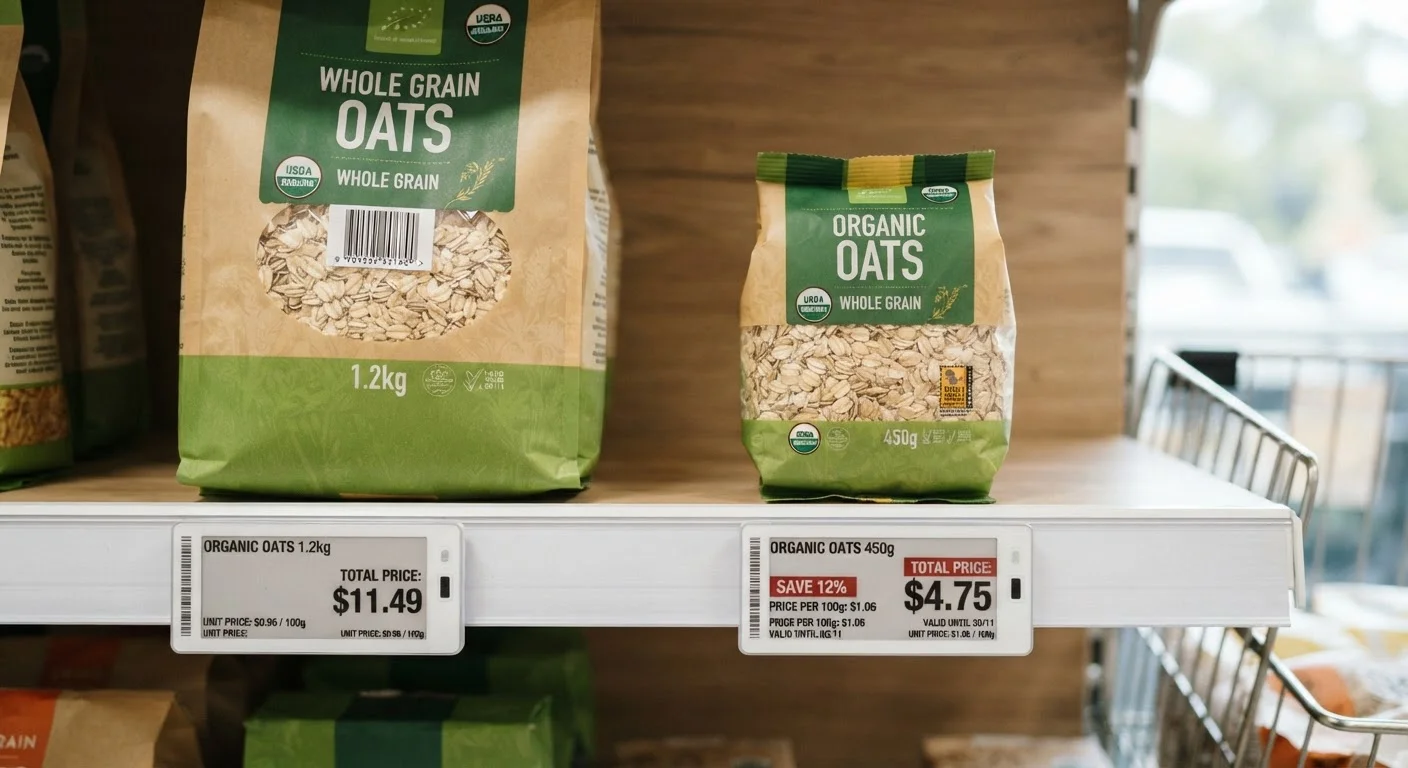
Photo: AdvisorBooth.net editorial
Key Takeaways
- Unit price divides cost by quantity, revealing true value independent of package size.
- Sticker price only tells you what you'll pay today, not whether you're getting a fair deal.
- Bulk buys can appear cheaper per unit but waste money if you don't use the product.
- Retailers aren't required to display unit prices uniformly, so you may need to calculate manually.
- Both numbers serve a purpose - use unit price for value, sticker price for budget checks.
- Shelf unit-price labels can contain errors; verify the math yourself on large purchases.
What Each Number Actually Means
The sticker price is simply the total dollar amount printed on the tag - the number the retailer leads with. It's what you see first, what your brain registers as "expensive" or "affordable," and what gets debited from your account at checkout.
The unit price is a derived figure: total price divided by a standard unit of measurement - ounces, count, square feet, fluid ounces, or whatever applies. A 32 oz bottle of dish soap priced at $4.80 has a unit price of $0.15 per ounce. A 16 oz bottle at $2.88 costs $0.18 per ounce. The sticker on the smaller bottle looks cheaper, but the unit price tells the opposite story.
Many grocery and big-box stores are required by state law to display unit prices on shelf tags, though requirements and formats vary by state. Even where displayed, the unit of measurement isn't always consistent across competing products - one brand might display price per ounce while another shows price per 100 grams - so direct comparison still takes a moment of attention. For a broader look at how pricing metrics interact, see the Comparing Value hub.
| Criterion | Unit Price | Sticker Price |
|---|---|---|
| What it measures | Cost per standard unit (oz, count, sq ft) | Total dollar amount on the tag |
| Best use | Comparing different sizes or brands | Budget and cash-flow planning |
| Calculation required | Yes - divide price by quantity | No - displayed directly |
| Misleads when | You won't use the full quantity | Package sizes differ across options |
| Displayed on shelf | Sometimes - varies by state law | Always |
| Accounts for bulk sizing | Yes - normalizes across sizes | No - larger packs look more expensive |
When Sticker Price Is the Right Lens
Sticker price isn't a flawed number - it's just answering a different question. When you're managing a fixed grocery budget, a tight paycheck period, or a one-time purchase you won't repeat, the absolute dollar amount is what matters. Buying a bulk pack of paper towels at a better unit price is a poor trade if it means not having enough left for produce.
Sticker price also matters when you factor in storage, spoilage, or usage rates. A giant jar of a condiment might win on unit price but lose badly once half of it spoils in your refrigerator. The same logic applies beyond groceries - price-per-square-foot comparisons in real estate can similarly mislead when you ignore absolute costs and practical constraints.
~66%
U.S. states with unit-pricing laws
Consumer advocacy research has estimated that roughly two-thirds of U.S. states have some form of unit-pricing regulation, though requirements and enforcement vary significantly.
30%+
Average household food waste by value
The USDA has estimated that American households discard a substantial share of the food they purchase, which directly undermines any savings from bulk unit pricing.
When Unit Price Should Win the Argument
Unit price becomes essential when you're comparing products that aren't the same size or count. Without it, packaging differences make comparison nearly impossible. Retailers know this - varying package sizes is a documented pricing strategy that makes direct cost comparison harder for consumers.
For non-perishable goods you use regularly - laundry detergent, canned goods, cleaning supplies, vitamins - buying the package with the lower unit price and using it fully is the straightforward path to spending less over time. This is the core logic behind cost-per-use thinking; cost per use applies the same principle to durable goods like tools or clothing.
It's also worth noting that a sale sticker doesn't guarantee a better unit price. A "buy two, save 10%" promotion can still leave you paying more per unit than the store-brand alternative sitting right next to it. Distinguishing a real deal from a discounted price requires checking the unit figure, not just the promotional tag.
How to Use Both Numbers Together
The practical move is a two-step check. First, use unit price to identify which option delivers the most per dollar. Second, use sticker price to confirm the purchase fits your budget and that you'll realistically use what you're buying.
A few habits that help:
- Calculate manually when in doubt. Shelf unit-price labels can contain errors or use different base units. Divide the sticker price by the package quantity on your phone's calculator to verify.
- Standardize the unit. If one label shows price per ounce and another shows price per pound, convert before comparing.
- Account for your actual consumption rate. A six-month supply of something you use weekly is a good deal; a six-month supply of something you use twice a year is not.
- Check whether quality is equivalent. Unit price comparison assumes similar quality - sometimes a higher price reflects a genuine quality difference worth paying for.
Neither number is complete on its own. Used together, they give you a full picture of what you're actually paying and whether that trade-off makes sense for your situation.
The content on this site is for informational purposes only and is not a substitute for professional advice. Always consult a qualified professional for guidance specific to your situation.