
Understanding Price Per Square Foot - and Its Limits

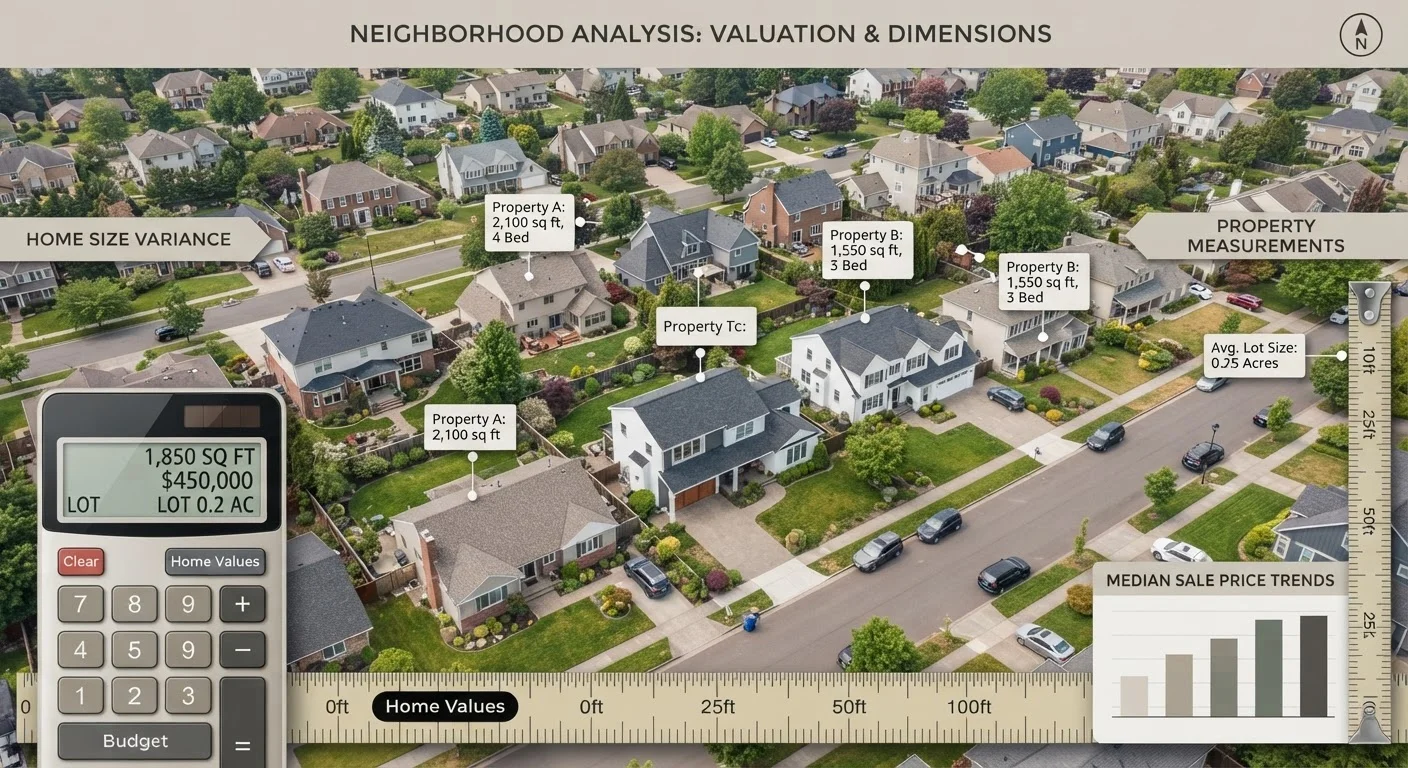
Photo: AdvisorBooth.net editorial
Key Takeaways
- Price per square foot divides a home's sale price by its finished square footage for quick market comparisons.
- PPSF is most reliable when comparing homes of similar size, age, condition, and location.
- Factors like lot size, finishes, layout, and views are invisible to PPSF but significantly affect value.
- Square footage itself is not always measured consistently across listings, introducing potential error.
- PPSF works best as one input among several, not as a stand-alone valuation tool.
How Price Per Square Foot Is Calculated - and Why It Exists
When comparing homes of different sizes, raw list price alone can be misleading. A $500,000 house sounds more expensive than a $350,000 one until you discover the first has 3,500 square feet and the second has 900. Price per square foot normalizes that difference, letting you evaluate cost on a common scale.
The math is straightforward: divide the sale price by the home's finished square footage. If a home sells for $360,000 and measures 1,800 square feet, its PPSF is $200. Repeat that across several recent comparable sales in a neighborhood, and you have a rough benchmark for what the local market values per unit of living space.
Real estate agents, appraisers, and online platforms use PPSF regularly as a first-pass comparison tool. It's particularly useful when analyzing market trends over time - rising PPSF across a neighborhood generally signals increasing demand. For a deeper look at how to interpret those trends accurately, see tracking local home values over time.
±10-15%
Typical square footage variance in MLS listings
Industry practitioners note that self-reported or assessor-based square footage figures can diverge from measured reality by meaningful margins, affecting PPSF accuracy.
20-30%
PPSF premium for smaller vs. larger homes
Real estate research consistently finds that smaller homes in a given market sell at a higher price per square foot than larger homes, due to the fixed-cost nature of kitchens, baths, and entries.
Where the Metric Breaks Down
PPSF is useful precisely because it simplifies - and it misleads for exactly the same reason. Several factors that strongly influence a home's value are entirely invisible to the calculation.
- Location within a neighborhood: Two homes with identical square footage on different streets - one backing a park, one facing a highway - can differ by tens of thousands of dollars. PPSF treats them the same.
- Quality of finishes: Hardwood floors, updated kitchens, and custom tile work all add value that raw square footage doesn't reflect. A home with builder-grade finishes and one with high-end renovations may show the same PPSF even though buyers will pay very differently for each.
- Floor plan efficiency: A well-designed 1,400-square-foot layout can feel more livable than a poorly planned 1,800-square-foot home. Buyers pay for usability, not just area.
- Lot size and outdoor space: A home on a quarter-acre lot and one on a postage-stamp lot have the same PPSF if their interiors match - despite very different total value propositions.
- Measurement inconsistency: Square footage figures in MLS listings are not always verified. Differences in how builders, appraisers, and sellers measure finished space can introduce meaningful inaccuracies.
This is similar to how focusing on a single number in any purchasing context can obscure the full picture - much like the way unit price vs. total price comparisons require context to be meaningful in everyday shopping.
Using PPSF as One Tool Among Several
The right way to use price per square foot is as a starting filter, not a verdict. Here's how to apply it responsibly:
- Compare apples to apples. PPSF comparisons are most valid between homes of similar size, age, style, and location. Comparing a 900-square-foot condo to a 3,000-square-foot single-family home using PPSF produces a distorted picture - larger homes almost always have a lower PPSF than smaller ones in the same market, simply because fixed costs like kitchens and bathrooms are spread over more area.
- Pair it with condition data. A low PPSF may signal a bargain - or deferred maintenance. Always investigate what's driving a below-market figure before drawing conclusions.
- Use multiple comparable sales. A single PPSF figure from one transaction can be an outlier. Averaging across five to ten recent, comparable sales gives a more reliable baseline.
- Consult a licensed appraiser or agent. Professionals use PPSF as one input within a comprehensive comparative market analysis (CMA) that accounts for adjustments PPSF cannot make on its own.
“Price per square foot is a useful starting point for orientation, but no single metric captures what makes a home worth what a buyer will pay. Context - condition, location, and comparable sales - is where the real analysis happens.”
— National Association of Realtors, Trade association representing real estate professionals in the United States
In the end, PPSF is a lens - helpful for initial orientation, but not a substitute for a thorough property analysis. Knowing its limits is what makes it useful rather than misleading.
Frequently Asked Questions
The content on this site is for informational purposes only and is not a substitute for professional advice. Always consult a qualified professional for guidance specific to your situation.