
Unit Price vs. Total Price: Which Number Should Guide Your Decision?

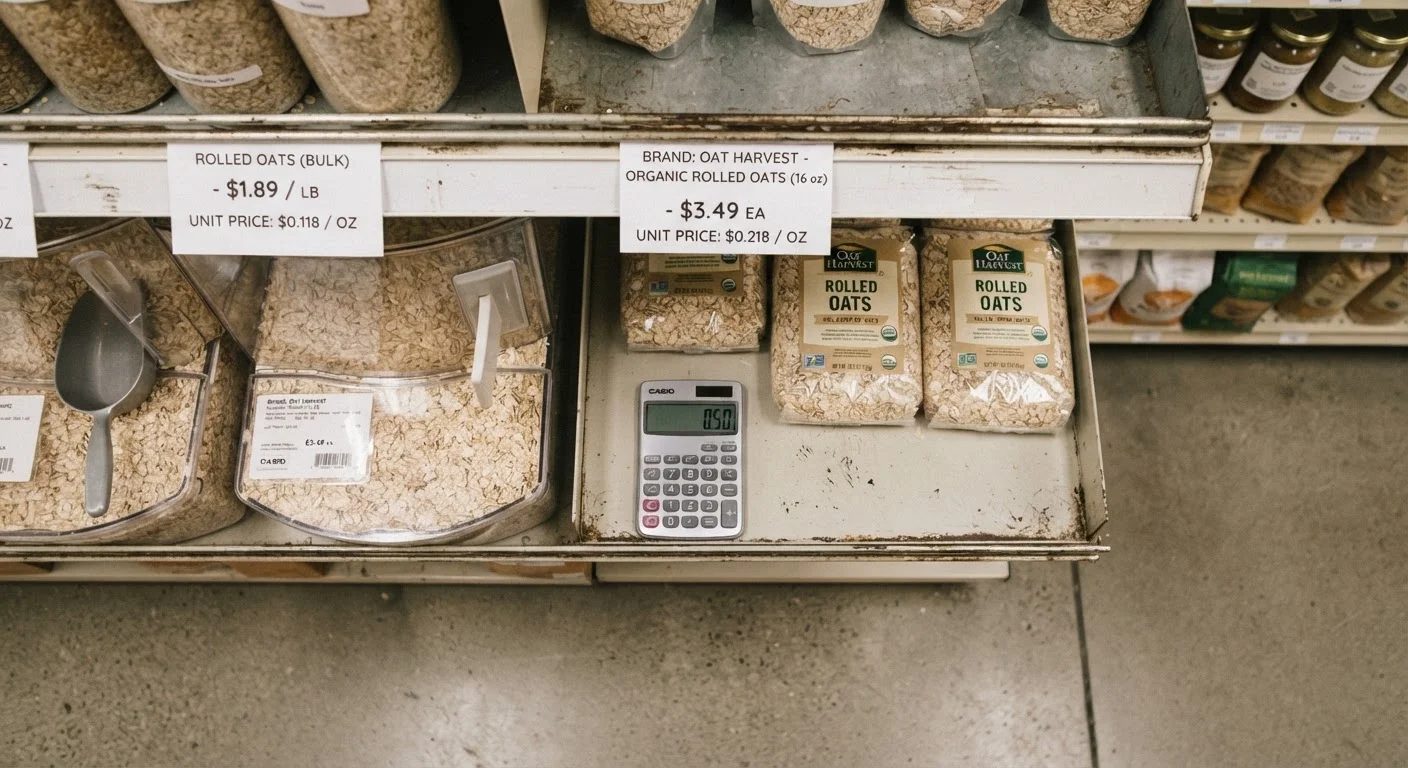
Photo: AdvisorBooth.net editorial
Key Takeaways
- Unit price lets you compare different package sizes on equal footing - it's the fairest measure of value.
- Total price determines whether a purchase fits your budget right now, regardless of per-unit savings.
- A lower unit price only saves money if you actually use the entire quantity before it expires or goes to waste.
- Retailers are required in many states to display unit pricing on shelf tags, so look for it before calculating manually.
- Neither number alone tells the full story - smart shoppers use both together.
What Each Number Actually Tells You
Unit price expresses cost relative to a standard measure - typically per ounce, per sheet, per count, or per fluid ounce. It strips away package size so you can compare a 12-oz bottle to a 32-oz bottle on the same terms. Total price is simply what you hand over at the register - the full dollar amount for whatever quantity is in the package.
Both numbers come from the same transaction, but they answer completely different questions. Unit price answers: Which option gives me the most for my money? Total price answers: Can I afford this right now, and does the amount make sense for my situation?
Many shoppers default to one or the other. Bargain-focused shoppers chase unit price and overbuy; budget-tight shoppers stick to total price and miss obvious value. The better approach uses both as filters - in sequence.
| Criterion | Unit Price | Total Price |
|---|---|---|
| What it measures | Cost per ounce, count, or unit | Full register cost of the package |
| Best use | Comparing different sizes fairly | Checking budget fit |
| Main risk if overused | Overbuying, waste, overspend | Missing better value in larger sizes |
| Perishable goods | Can mislead if waste is likely | More reliable guide to actual spend |
| Non-perishable staples | Strong predictor of long-term savings | Less useful beyond cash-flow check |
| Displayed on shelf tags? | Often yes, varies by state | Always |
When Unit Price Should Win the Argument
Unit price is your most powerful tool when you're comparing products that come in different sizes or formats. A store-brand laundry detergent in a 150-oz jug might have a higher total price than the 75-oz name-brand bottle, but the unit price often tells a different story. Without doing the math - or reading the shelf tag - many shoppers assume smaller means cheaper.
U.S. retailers in many states are legally required to display unit pricing on shelf tags alongside the total price, though the format varies. When that information is present, use it. When it isn't, the math is simple: divide total price by the number of units (ounces, count, etc.).
Unit price matters most for:
- Non-perishable goods you'll use consistently (paper products, canned goods, cleaning supplies)
- Products you buy repeatedly - small unit-price differences compound over dozens of purchases
- Items where package sizes vary significantly between retailers or store brands
For a related perspective on how price-per-measure applies beyond the grocery aisle, see how price per square foot can mislead home buyers.
~30%
Average food waste in U.S. households
The USDA estimates American households waste roughly 30-40% of the food supply, often tied to overbuying driven by apparent bulk savings.
32 states
States with unit pricing regulations
According to consumer protection research, approximately 32 U.S. states have some form of unit pricing requirement for retail stores, though enforcement and display standards vary.
When Total Price Deserves More Weight
A low unit price can be financially counterproductive if the total outlay is more than you should spend, or if buying that quantity creates waste. This is one of the most common traps in warehouse shopping: the unit economics look excellent, but you spend $60 on a product you'd have bought for $18 at a smaller size - and used just as effectively.
Total price should lead your decision when:
- Perishability is a factor. Fresh produce, dairy, and even some medications have expiration windows. If you can't realistically use the quantity, the unit savings evaporate.
- Storage is limited. A great deal on bulk paper towels means nothing if you have nowhere practical to store them.
- Cash flow is the binding constraint. Paying more upfront to save per unit only makes sense if the upfront spend doesn't create financial stress or opportunity cost.
This logic applies well beyond groceries. When buying a vehicle, focusing only on a monthly payment figure - rather than the total financed amount - is a classic example of total-price blindness working in reverse. Negotiating on monthly payment alone can obscure the true cost of a deal.
Store-Brand Unit Prices Often Beat Name Brands
A Practical Framework: Use Both, in the Right Order
The most reliable approach is sequential: use unit price to identify the genuinely better value, then use total price as a reality check on whether that value actually applies to your situation.
- Find the unit price. Check the shelf tag or divide total price by quantity. Pick the option with the lowest cost per standard unit - that's your value winner.
- Apply the waste test. Will you realistically use all of it? If not, recalculate: factor in the portion you'll discard and the effective unit price climbs.
- Apply the budget test. Does the total price fit your current spending plan? If not, the per-unit saving is theoretical, not real.
- Consider cost per use. For durable goods, neither unit price nor total price fully captures value. Cost per use - dividing price by expected uses - adds another layer of clarity.
Neither number is universally superior. The skill is knowing which question you're actually trying to answer before you pick up the package. And when a sale price is involved, it's worth remembering that a discount on the total price doesn't automatically make the unit price competitive. A marked-down price isn't always a genuinely good price.
The content on this site is for informational purposes only and is not a substitute for professional advice. Always consult a qualified professional for guidance specific to your situation.