
Little-Known Ways Stores Encourage You to Spend More Than You Planned

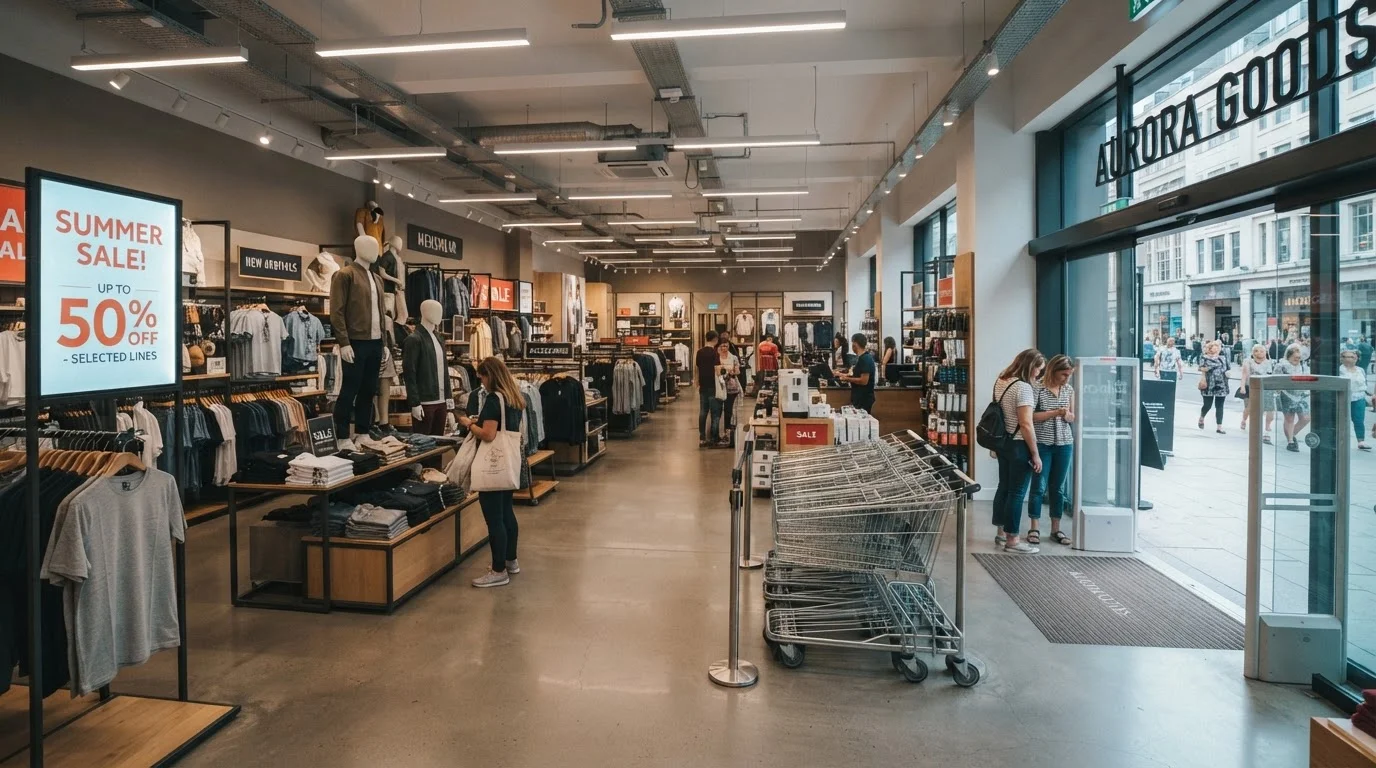
Photo: AdvisorBooth.net editorial
Key Takeaways
- Retail environments are carefully engineered to increase average spending through layout, lighting, and pricing cues.
- Anchor pricing and decoy options distort your sense of what counts as a fair or reasonable price.
- Friction-reducing tactics like one-click checkout and saved cards accelerate unplanned purchases.
- Awareness of these tactics doesn't eliminate their effect - having a concrete plan before you shop does.
- Small structural habits, like shopping with a list and avoiding hunger, measurably reduce impulse spending.
The Store Is Not Neutral Territory
Most people assume retail spaces are simply warehouses organized for convenience. They're not. Every element - from the width of the aisles to the placement of the bread and milk in grocery stores - reflects deliberate decisions aimed at maximizing the time you spend inside and the size of your basket when you leave.
This isn't conspiracy thinking. It's standard retail science, documented in trade publications and consumer behavior research for decades. Chains invest significantly in store design, planogram testing, and checkout flow optimization. The goal is to intercept shoppers at decision points and tilt those decisions toward spending more.
Understanding how these systems work is one of the most practical things you can do for your budget. It complements what you'd find in a complete everyday saving strategies guide and pairs directly with the mental patterns explored in why shoppers consistently overpay. Below are the tactics worth knowing.
High-margin items at eye level
Shelf placement is sold and negotiated - it's not random. Products positioned at adult eye level (roughly 4-5 feet from the floor) consistently outsell those placed lower or higher. Retailers and suppliers know this, which is why store-brand or lower-margin items are often shelved below eye level while premium products command center-stage placement.
A simple counter: scan the full shelf vertically before picking anything. The product that catches your eye first may not be the most useful or economical choice for your situation.
The product that catches your eye first may not be the most useful or economical choice.
Anchor pricing that warps your reference point
When a price tag shows "Was $80, Now $49," your brain anchors to the $80 and experiences the $49 as a gain - even if the item was never routinely sold at $80, or if $49 is simply the standard retail price elsewhere. This anchoring effect is one of the most studied phenomena in consumer psychology.
The antidote is to evaluate the actual price against your need, not against the crossed-out number. Ask: would I pay $49 for this if there were no "original" price displayed?
Ask yourself: would you pay this price if no 'original' price were shown?
Decoy options that make the middle tier look reasonable
Retailers and restaurants frequently offer three tiers - small, medium, and large - where the small is priced to seem poor value, the large to seem extravagant, and the medium to seem like the sensible choice. The medium is often the highest-margin option and was the intended target all along. The cheap and expensive options exist primarily to frame it.
This pattern also appears in subscription plans, streaming tiers, and software pricing. Recognizing the three-option frame helps you evaluate whether the "middle" option actually meets your needs or just feels justified by comparison.
In three-tier pricing, the middle option is usually the highest-margin choice by design.
Sensory environment cues that slow you down
Slower tempo music, pleasant scents in bakery or candle sections, and warm lighting all encourage shoppers to linger. Research in retail atmospherics suggests that extended time in store correlates with increased spending. These aren't accidents - they're designed conditions.
Online equivalents include autoplay videos, infinite scroll, and ambient product photography. The longer you browse, the more likely you are to add unplanned items. Shopping with a time constraint - setting a physical or mental limit on how long you'll spend in store or on a site - can meaningfully limit this effect.
Extended browsing time, in-store or online, reliably increases unplanned spending.
Frictionless checkout that bypasses reflection
One-click ordering, saved payment credentials, and express checkout lanes all reduce the moment of pause that naturally occurs when you have to retrieve a wallet, enter a card number, or wait in line. That pause, however brief, is a natural decision checkpoint where second thoughts happen.
Stores and apps have systematically eliminated that checkpoint. Adding it back artificially - by paying with cash, removing saved card details, or simply pausing to review your cart before finalizing - restores the reflection step. It's a small friction that has an outsized impact on unplanned purchases, as discussed further in the psychology behind impulse buying.
The checkout pause is a natural decision checkpoint - and retailers have worked hard to remove it.
Bundle and threshold offers that push cart size up
"Buy 3, get 1 free" and "Free shipping on orders over $50" are threshold offers - they set a target that encourages you to add items you hadn't planned to purchase. The math often works out for the retailer even when the stated discount looks generous, because the incremental items added to hit the threshold carry their own margin.
Before adding items to reach a threshold, check whether the total you'd spend - including the extras - is actually less than buying only what you needed and paying the lower-tier price or shipping cost. Sometimes it is. Often it isn't. For grocery specifics, smart grocery shopping habits cover how to evaluate these deals in a weekly shopping context.
Items added to hit a spend threshold often cost more than the shipping fee or discount you're avoiding.
What You Can Do About It
Awareness helps, but it doesn't fully neutralize these effects - retailers have spent enormous resources ensuring their cues work even on informed shoppers. What actually moves the needle is pre-commitment: making decisions before you enter a store or open an app, rather than inside the environment designed to influence you.
Shopping with a written list - and treating it as a constraint rather than a suggestion - consistently outperforms relying on willpower alone. So does setting a specific dollar limit before browsing sales events. For online shopping, removing saved payment information adds friction that can interrupt automatic checkout behavior; the tradeoffs around saving card details are worth understanding on their own terms.
If you find yourself regularly going over budget without knowing exactly why, saving strategies that don't require strict budgeting offer lower-friction alternatives that work with the psychology rather than against it. And before enrolling in another loyalty program, it's worth asking whether it's genuinely saving you money or quietly encouraging you to spend more to earn rewards - how to evaluate loyalty programs honestly lays that out clearly.
Build Your Defenses Before You Enter
The content on this site is for informational purposes only and is not a substitute for professional advice. Always consult a qualified professional for guidance specific to your situation.