
The Neighborhood Factors That Quietly Shape Your Home's Worth

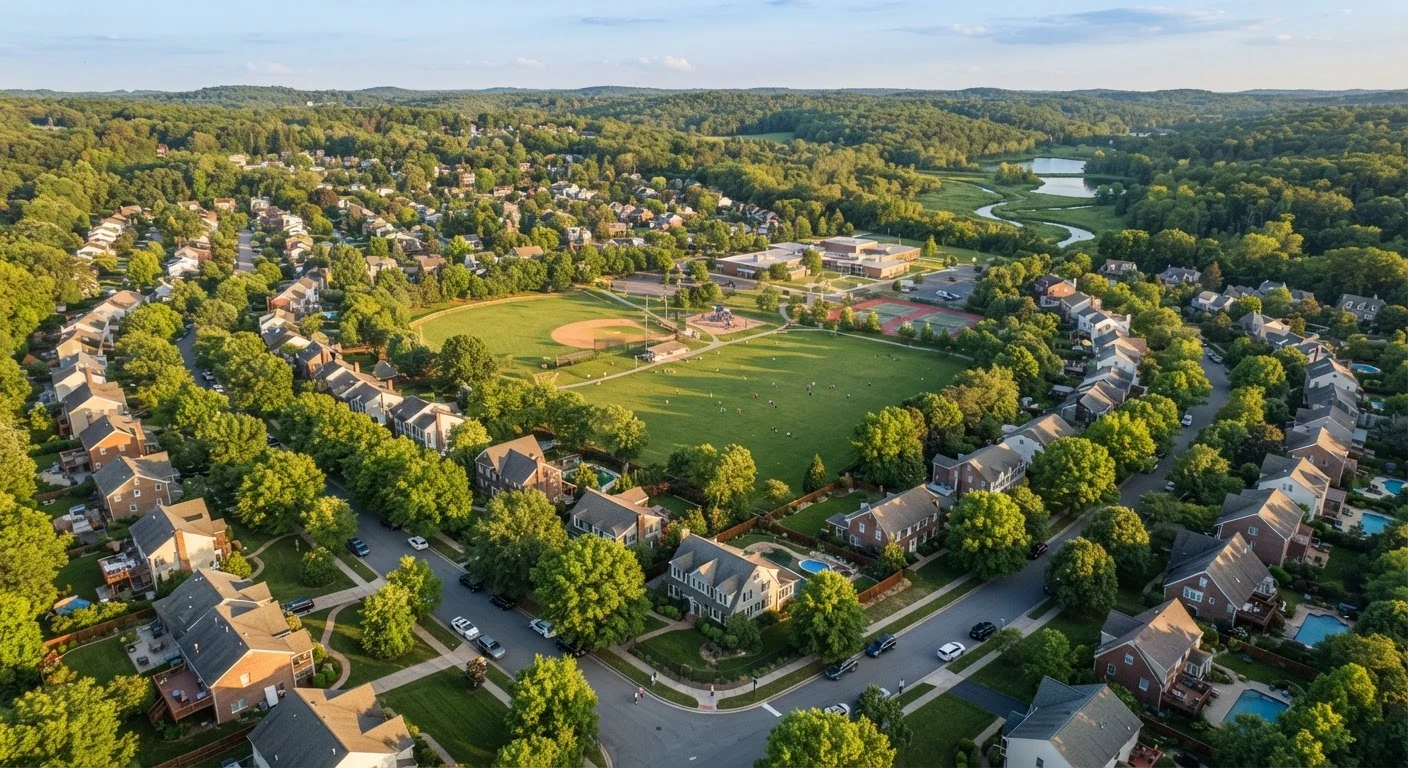
Photo: AdvisorBooth.net editorial
Key Takeaways
- School district quality consistently ranks among the most powerful drivers of residential property values.
- Walkability scores and transit access affect buyer demand and can shift prices even within the same zip code.
- Nearby development - both planned and completed - can push values up or create long-term uncertainty.
- Crime trends influence buyer perception strongly, but the data source and timeframe matter.
- Local tax rates and municipal services are often overlooked but directly affect a home's true cost of ownership.
Why Location Goes Deeper Than You Think
Every real estate professional eventually lands on the same phrase: location, location, location. But that shorthand masks something more complex. It isn't just the city or the street - it's a layered set of neighborhood characteristics that buyers, lenders, and appraisers all weigh when determining what a home is actually worth.
Understanding those factors gives you a meaningful edge, whether you're buying, selling, or simply trying to make sense of what you see in local market reports. For a broader framework on how homes are formally valued, see our comprehensive valuation resource. The factors below are the neighborhood-level variables that quietly - and sometimes dramatically - move the numbers.
School District Quality
Even buyers without school-age children factor district quality into their decisions, because strong school ratings correlate with sustained buyer demand - and demand sustains prices. Research consistently shows that homes within higher-rated districts command premiums over comparable properties in adjacent districts, sometimes ranging from several percentage points to significantly more in competitive markets.
The mechanism is straightforward: families with children actively seek out strong schools, and their competition for limited inventory in those zones pushes prices upward. That demand doesn't evaporate during market downturns the same way it can in lower-rated districts, which partly explains why school zone homes often hold value more resiliently over time.
It's worth noting that school ratings reflect a snapshot in time. District demographics, state funding formulas, and leadership all shift. Before assuming a rating will hold, look at trends over several years rather than a single score.
Even buyers without children factor school district ratings into their offers - demand sustains prices.
Walkability and Transit Access
Walk Score and similar indices attempt to quantify something that buyers feel intuitively: the convenience of reaching daily needs on foot or without a car. Neighborhoods with high walkability tend to attract buyers who are willing to pay for that convenience, particularly in urban and inner-suburban markets.
Transit access adds another layer. Proximity to rail stations, reliable bus corridors, or bike infrastructure expands who can live in a neighborhood without relying entirely on a car. Studies of transit-adjacent development patterns have found that homes within a short walk of rail stations can carry meaningful premiums over comparable homes further out - though local market conditions and the quality of the transit system both temper that effect.
Walkability also signals something about neighborhood density and commercial vitality - the presence of shops, restaurants, and services that many buyers view as quality-of-life markers.
High walkability signals commercial vitality and attracts buyers willing to pay a premium for convenience.
Crime Trends and Public Safety Perception
Crime statistics influence buyer psychology strongly, but they require careful interpretation. Published crime rates vary depending on the reporting agency, which crimes are counted, and whether data is reported at the city, precinct, or neighborhood level. A neighborhood with declining crime over several years tells a very different story than one with a single anomalous incident that skewed recent counts.
Buyers and their agents increasingly review crime mapping tools alongside traditional listing data. Areas with improving safety trends - visible infrastructure investment, active community organizations, or increased lighting - can see upward price pressure even before those improvements fully register in statistics.
Property appraisers don't directly input crime rates as a line item, but they do reflect neighborhood desirability through comparable sales selection. If recent sales in higher-crime areas show consistent discounts relative to similar properties nearby, that gap becomes embedded in valuations.
Declining crime trends can drive price appreciation even before improvements fully show in official statistics.
Nearby Development and Land Use Changes
Planned or recent development near a property creates a branching path for value: it can be a catalyst or a concern, depending on what's being built. A new mixed-use development anchored by retail and green space tends to signal investment in an area and can lift surrounding residential values. A large industrial facility, waste transfer station, or highway expansion can have the opposite effect.
Zoning changes are the upstream signal. When a municipality re-zones parcels near a residential area for denser or commercial use, it's worth tracking what that actually permits. Public planning meetings, county zoning portals, and local news coverage are all legitimate ways to monitor what's in the pipeline before it affects market prices.
Buyers who research pending development can sometimes identify neighborhoods on the cusp of appreciation - though this carries uncertainty. Values can also be suppressed during a construction period and recover once projects are completed.
Zoning changes near a property are an upstream signal worth tracking before they affect market prices.
Property Tax Rates and Municipal Services
Property taxes directly affect the cost of owning a home and, by extension, what buyers are willing to pay. Two homes with identical list prices in neighboring municipalities can carry very different effective costs if their annual tax bills differ substantially. This is particularly relevant in states with wide variation in local millage rates or assessment practices.
The services those taxes fund also matter. Well-maintained roads, responsive municipal services, public parks, and library systems all contribute to neighborhood desirability. Buyers and appraisers don't always itemize these inputs consciously, but they're reflected in the pattern of where people choose to live and what they pay to do so.
Some areas with lower tax rates also have lower service levels, which may suit some buyers but deter others. Understanding the full picture - rate, assessment method, and what's funded - is part of interpreting any home's true carrying cost.
Two identical homes in neighboring municipalities can carry very different effective costs due to tax rate variation.
Neighborhood Trajectory and Social Capital
Perhaps the hardest factor to quantify is whether a neighborhood is improving, stable, or declining. Buyers and appraisers read signals: new business openings, home renovation activity, community event infrastructure, and the general upkeep of public and private spaces. These aren't infallible indicators, but they shape the narrative buyers construct about where a neighborhood is headed.
Social capital - the strength of community organizations, neighborhood associations, and civic engagement - also plays a quiet role. Neighborhoods with active associations that maintain common areas, enforce deed restrictions, or successfully advocate for local improvements tend to protect property values over time more effectively than atomized areas where no organized voice exists.
This is one area where broader economic forces intersect with hyperlocal dynamics. A rising tide of regional demand can lift even transitional neighborhoods, while a regional downturn can stress even stable ones.
Active neighborhood associations and civic engagement are quiet protectors of long-term property values.
Putting It All Together
No single neighborhood factor determines a home's worth in isolation. Appraisers and buyers weigh them collectively, and their relative importance shifts depending on who's buying and why. A young family may prioritize school ratings above all else; a remote worker may weight walkability and commute options less heavily than a transit-dependent buyer would.
What these factors share is that they're largely outside any individual homeowner's control - which makes staying informed about your local market especially valuable. Neighborhood conditions evolve over time, and the same home can appreciate or stagnate depending on how surrounding dynamics shift. Tracking local home values accurately requires looking at these signals alongside raw price data. For those concerned about what might be quietly working against their property, it's also worth reviewing location-related issues that appraisers and buyers flag most often.
Research Neighborhood Trends Before You Commit
The content on this site is for informational purposes only and is not a substitute for professional advice. Always consult a qualified professional for guidance specific to your situation.