
Property Valuation From Every Angle: The Definitive Resource

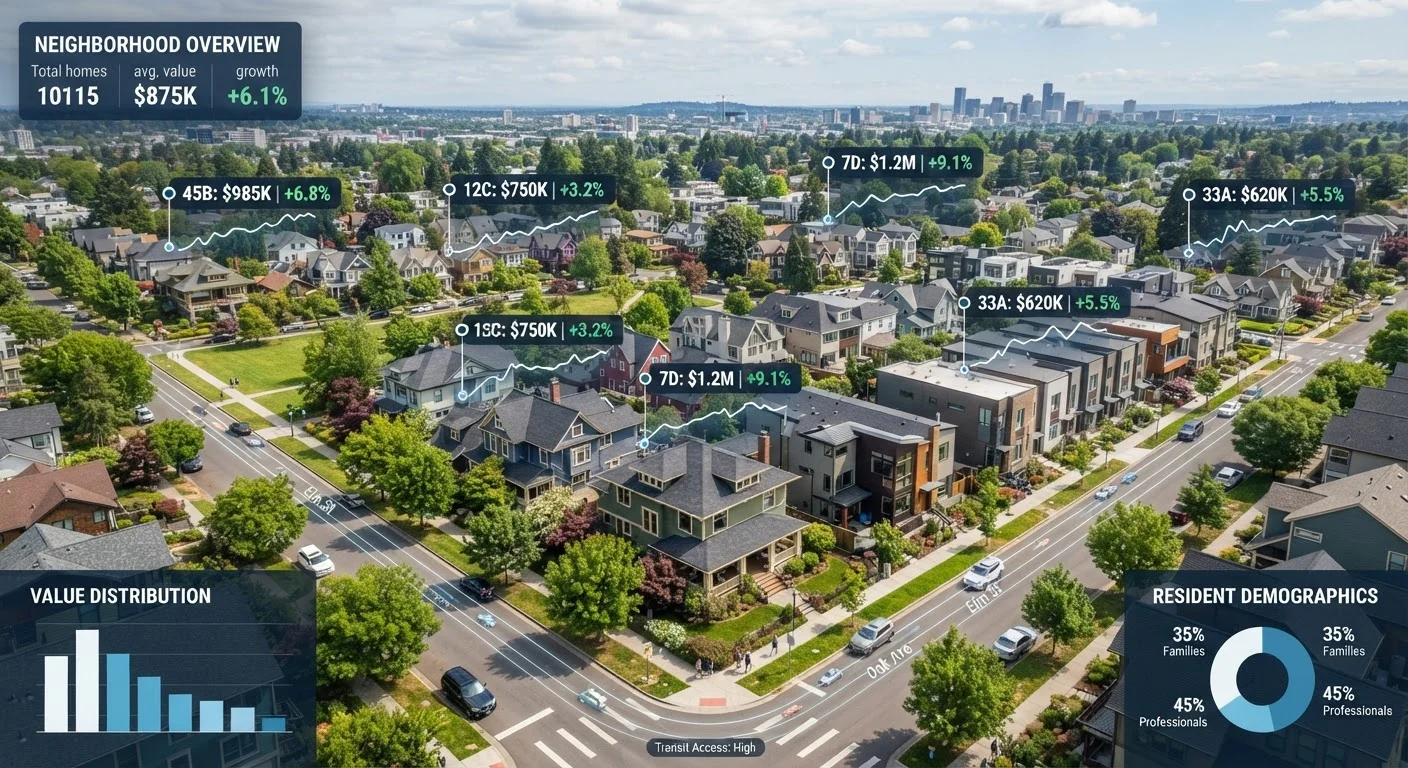
Photo: AdvisorBooth.net editorial
Key Takeaways
- Appraisers use three distinct methods - sales comparison, cost, and income - each suited to different property types.
- Local market conditions, including inventory levels and interest rates, directly influence what comparable sales can support.
- Not all renovations return their full cost at resale; kitchen and bathroom updates tend to offer stronger value retention.
- Automated valuation models (AVMs) provide quick estimates but carry meaningful error margins in thin or volatile markets.
- Understanding the inputs behind any valuation number lets buyers and sellers negotiate from a position of knowledge.
Why Property Valuation Matters
Whether you are buying, selling, refinancing, or simply tracking your net worth, the assessed or appraised value of a home shapes nearly every financial decision attached to it. Lenders rely on valuations to determine how much they will loan. Tax authorities use assessed values to calculate property taxes. Sellers use market value estimates to set asking prices, while buyers use them to gauge whether an offer is reasonable.
The challenge is that "value" is not a single number. A home can simultaneously carry an assessed value (set by a local government assessor), an appraised value (produced by a licensed appraiser for a lender), and an estimated market value (generated by an algorithm or a real estate agent's comparative analysis). Each figure is calculated differently and serves a distinct purpose. Conflating them is one of the most common sources of confusion for buyers and sellers alike.
This guide walks through each valuation method, the market forces that move values, and how to interpret the numbers you encounter - so you can engage with the process as an informed participant rather than a passive bystander.
The Three Core Appraisal Approaches
Licensed appraisers are trained to estimate value using one or more of three recognized methodologies, depending on the property type and available data.
When reviewing an appraisal, check whether the comps used are truly in the same school district and subdivision - appraisers working outside their core geography sometimes pull comps from adjacent areas that buyers would never treat as equivalent.
Before listing, request a pre-listing appraisal if your home has unusual features, significant renovations, or few nearby sales - it gives you a defensible anchor for your asking price and can reduce negotiation friction.
Sales Comparison Approach
The most widely used method for residential properties, this approach identifies recently sold homes that are similar in size, condition, location, and features - known as comparables or "comps." The appraiser adjusts each comp's sale price up or down to account for differences between it and the subject property, then reconciles those adjusted figures into a value conclusion. The quality of this method depends heavily on the availability of genuinely similar recent sales.
Cost Approach
This method estimates what it would cost to rebuild the structure from scratch using current labor and material costs, then subtracts depreciation and adds the value of the land. It is most relevant for new construction, unique properties with few comps, and insurance purposes. The cost approach does not reflect market sentiment - a home may be worth less than its replacement cost in a depressed market, or more in a competitive one.
Income Approach
Used primarily for rental and investment properties, this method values a property based on the income it generates or could generate. A key metric is the capitalization rate (cap rate) - the ratio of net operating income to property value. Higher projected income, or a lower cap rate in a high-demand area, pushes value upward. For owner-occupied single-family homes, this method is rarely the primary approach. See our full walkthrough of the appraisal process to understand how appraisers weigh these methods in practice.
Market Indicators That Shape Home Values
No valuation method operates in a vacuum. Local and national market conditions act as a backdrop against which all property-specific data is interpreted.
3-6 months
Supply threshold defining buyer vs. seller markets
Industry practitioners commonly use months of supply as a benchmark: below 3 months signals a seller's market; above 6 months favors buyers.
~7%
Typical AVM median error rate
Research from various AVM providers and independent analysts suggests median error rates for major AVMs generally fall between 2% and 7%, with wider variance in low-volume markets.
60-80%
Average cost recouped on minor kitchen remodel
Industry remodeling cost-versus-value studies have consistently found minor kitchen remodels among the higher-returning renovation categories at resale, though figures vary by region and market cycle.
Supply and Demand
When active listings are low relative to buyer demand, prices rise because buyers compete for fewer options. When inventory swells, sellers must price more competitively. Months of supply - the time it would take to sell all current listings at the current pace - is a standard measure; markets below three months of supply are generally considered seller's markets, while above six months tends to favor buyers.
Interest Rates
Mortgage rates affect how much purchasing power a buyer has at any given income level. When rates rise sharply, buyers qualify for smaller loan amounts, which can compress the prices sellers realistically achieve - particularly in markets where buyers were already stretching budgets. This dynamic is a core reason why home prices and interest rates often move in opposite directions, though local factors can override national trends.
Location-Specific Factors
School district ratings, walkability scores, proximity to employment centers, local crime statistics, and planned infrastructure investments all influence buyer willingness to pay. These are not abstract considerations - appraisers and agents must quantify their impact through market data, which can be difficult when the factors are qualitative.
How Renovations Affect Valuation
A common misconception is that every dollar spent improving a home returns at least a dollar in added value. In practice, the relationship is more nuanced and market-dependent.
Focus Renovations on What Buyers Notice First
According to data regularly compiled by industry organizations tracking remodeling costs versus resale value, certain projects consistently return a higher share of their cost than others. Minor kitchen remodels, bathroom updates, and exterior improvements such as new garage doors or entry doors have historically recouped a larger percentage of project cost at resale than major additions or luxury upgrades. However, these figures are averages across many markets and property types - individual results vary.
The Over-Improvement Problem
When a home is renovated significantly above the price ceiling for its neighborhood, the investment is unlikely to be recovered at sale. Appraisers and buyers will compare the property to surrounding homes, and no amount of high-end finishes can push value far above what the local market will support. This is called over-improvement, and it is one of the most common renovation mistakes in real estate.
Deferred Maintenance vs. Upgrades
Addressing deferred maintenance - replacing a failing roof, updating an aging HVAC system, or fixing structural issues - typically protects existing value rather than adding new value. Buyers and appraisers discount properties with known deficiencies, so repairs often produce a stronger return than discretionary upgrades in the same dollar range.
Automated Estimates vs. Professional Appraisals
Automated valuation models (AVMs) - the technology behind tools that generate instant home value estimates - apply statistical algorithms to public records data, recent sales, and property characteristics to produce a figure in seconds. They are convenient, free, and useful for ballpark orientation. However, their accuracy degrades significantly in markets with low sales volume, in neighborhoods with highly diverse housing stock, or when a property has been recently renovated without corresponding permit records.
Our detailed analysis of AVM methodology and limitations covers how these tools are built and where they reliably fall short. For any transaction where money is on the line, an AVM estimate should be treated as a starting point - not a conclusion.
Never Rely on an AVM for a Major Transaction
A licensed appraisal, ordered through a lender or independently, involves a physical inspection, professional judgment, and accountability under state licensing requirements. It costs more and takes more time, but provides a defensible, well-documented estimate grounded in local knowledge that no algorithm currently replicates with consistent reliability.
Reading the Numbers With Confidence
When you encounter a valuation figure - whether on a listing platform, in an appraisal report, or from a real estate agent's comparative market analysis - ask four questions to put it in context:
- What method produced this number? A sales comparison comp analysis, a cost approach, an AVM, or an assessed value each mean something different.
- How recent are the inputs? Comps older than six months may not reflect current market conditions, especially in volatile environments.
- How similar are the comparables? Geographic proximity and physical similarity matter greatly. A comp a mile away with a different school district is a weaker reference point.
- Who produced this estimate and why? A listing agent's market analysis is designed to support a pricing decision. A lender-ordered appraisal protects the lender's collateral interest. These different incentive structures can lead to different numbers on the same property.
Property valuation is ultimately an informed estimate, not an exact science. Prices at which homes actually sell are set by negotiation between specific buyers and sellers at a specific moment in time. Understanding this - and knowing how to critically evaluate the figures put in front of you - is the real-world skill this guide is designed to build. For a broader look at how value is assessed across different contexts, see how value evaluation works across different purchase categories.
This article is for general informational and educational purposes only and does not constitute financial, legal, or real estate advice. Consult a licensed real estate professional, appraiser, or financial adviser for guidance specific to your situation.
The content on this site is for informational purposes only and is not a substitute for professional advice. Always consult a qualified professional for guidance specific to your situation.