
Automated Valuation Models: Useful Tool or Oversimplified Estimate?

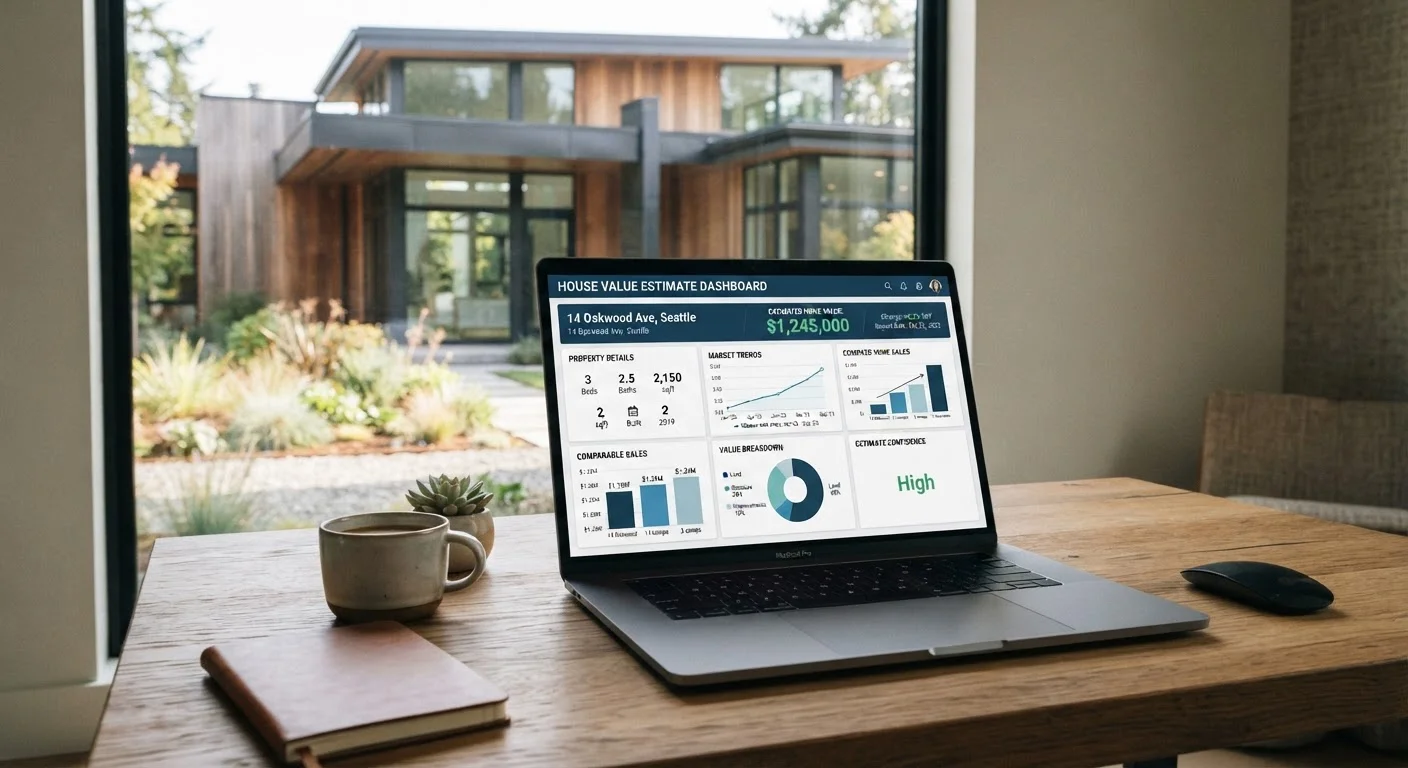
Photo: AdvisorBooth.net editorial
Key Takeaways
- AVMs use public records and algorithms to generate instant home value estimates without a physical inspection.
- Accuracy varies significantly by location, data availability, and how recently nearby homes have sold.
- AVMs work best as a starting point for research, not as a substitute for a formal appraisal.
- Unique property features, renovations, and condition are largely invisible to AVM algorithms.
- Lenders, investors, and consumers use AVMs differently - understanding the context matters.
Instant estimates available at no cost
Consumer AVM tools are free and generate results in seconds, making them accessible to anyone researching property values without professional assistance.
Useful for broad market trend monitoring
Tracking AVM estimates over time in a target area can reveal directional price movement, helping buyers and investors gauge market momentum.
Covers virtually every residential property in the US
Because AVMs draw on public records, they can produce estimates for millions of properties, including homes not currently listed for sale.
Helpful for preliminary portfolio screening
Real estate investors evaluating large numbers of properties can use AVMs to quickly filter candidates before investing in detailed due diligence.
Reduces reliance on potentially biased seller representations
An independent, data-driven figure gives buyers a baseline reference point that doesn't originate from a party with an interest in the sale price.
Cannot account for interior condition or upgrades
Algorithms have no visibility into renovation quality, appliance age, structural issues, or cosmetic condition - factors that can shift a property's true value by tens of thousands of dollars.
Accuracy degrades in low-transaction markets
Rural areas and markets with few recent comparable sales produce significantly wider AVM error ranges, sometimes making the estimate nearly meaningless.
Lags behind rapidly shifting market conditions
Because models depend on historical transaction data, estimates in fast-moving markets - both appreciating and declining - can lag actual current values by weeks or months.
Struggles with unique or atypical properties
Waterfront homes, historic properties, homes with irregular lot sizes, or properties with non-standard configurations lack close comparables, reducing AVM reliability substantially.
Not accepted as a substitute for licensed appraisals
Mortgage lenders generally require a certified appraisal for purchase and refinance transactions; an AVM figure carries no weight in these formal processes.
Methodology and data sources vary by platform
Different AVM tools use different algorithms and data inputs, which is why estimates for the same property can diverge significantly across platforms - there is no single authoritative figure.
What Is an Automated Valuation Model?
An Automated Valuation Model (AVM) is a software-driven system that estimates a property's market value using statistical algorithms applied to publicly available data. Inputs typically include recorded sale prices of nearby homes, property tax assessments, square footage, lot size, bedroom and bathroom counts, and local price trends derived from MLS data.
The most widely recognized consumer-facing AVMs are tools like Zillow's Zestimate, Redfin's Estimate, and Realtor.com's home value tool. Lenders and mortgage servicers also rely on proprietary, more sophisticated AVMs for portfolio monitoring and certain low-risk loan decisions. The common thread: no licensed appraiser physically visits the property.
It's worth distinguishing AVMs from the other figures you may encounter. As explained in our overview of assessed value, appraised value, and market value, each number serves a different purpose - an AVM estimate is closest to an attempt at market value, but with meaningful caveats. For a broader view of how properties are valued across different methodologies, see the comprehensive guide to property valuation.
The Advantages of AVMs
Instant estimates available at no cost
Consumer AVM tools are free and generate results in seconds, making them accessible to anyone researching property values without professional assistance.
Useful for broad market trend monitoring
Tracking AVM estimates over time in a target area can reveal directional price movement, helping buyers and investors gauge market momentum.
Covers virtually every residential property in the US
Because AVMs draw on public records, they can produce estimates for millions of properties, including homes not currently listed for sale.
Helpful for preliminary portfolio screening
Real estate investors evaluating large numbers of properties can use AVMs to quickly filter candidates before investing in detailed due diligence.
Reduces reliance on potentially biased seller representations
An independent, data-driven figure gives buyers a baseline reference point that doesn't originate from a party with an interest in the sale price.
The speed and accessibility of AVMs make them genuinely valuable for preliminary research. A homeowner curious about neighborhood trends, a buyer tracking a target market over several months, or an investor screening a large list of potential acquisitions all benefit from instant, no-cost estimates.
In markets with high transaction volume and dense comparable sales data - many suburban neighborhoods and urban cores - AVM accuracy can be reasonably strong. Zillow has publicly reported median error rates for its Zestimate, which tend to be lower in markets with robust data and higher where sales are sparse. These figures can shift with market conditions, so it's worth checking current published accuracy disclosures directly from each platform.
The Limitations You Need to Understand
Cannot account for interior condition or upgrades
Algorithms have no visibility into renovation quality, appliance age, structural issues, or cosmetic condition - factors that can shift a property's true value by tens of thousands of dollars.
Accuracy degrades in low-transaction markets
Rural areas and markets with few recent comparable sales produce significantly wider AVM error ranges, sometimes making the estimate nearly meaningless.
Lags behind rapidly shifting market conditions
Because models depend on historical transaction data, estimates in fast-moving markets - both appreciating and declining - can lag actual current values by weeks or months.
Struggles with unique or atypical properties
Waterfront homes, historic properties, homes with irregular lot sizes, or properties with non-standard configurations lack close comparables, reducing AVM reliability substantially.
Not accepted as a substitute for licensed appraisals
Mortgage lenders generally require a certified appraisal for purchase and refinance transactions; an AVM figure carries no weight in these formal processes.
Methodology and data sources vary by platform
Different AVM tools use different algorithms and data inputs, which is why estimates for the same property can diverge significantly across platforms - there is no single authoritative figure.
The core problem is that algorithms cannot see inside a home. A property with a fully renovated kitchen, high-end finishes, or significant deferred maintenance looks identical to a standard home in the data. This means AVMs tend to regress toward average condition - overvaluing neglected properties and undervaluing well-maintained or upgraded ones.
Rural properties and homes with unusual characteristics (waterfront lots, historic designations, large acreage) are particularly prone to AVM error, simply because comparable sales are rare or structurally dissimilar. Rapidly appreciating or declining markets also expose AVM weaknesses, since algorithms rely on historical transactions that may not reflect today's pricing environment.
For any transaction where money is actually on the line, an AVM is not a substitute for a formal appraisal or comparative market analysis. Mortgage lenders typically require a licensed appraisal for this reason.
AVMs and Mortgage Lending
How to Use AVMs Responsibly
Treat any AVM estimate as a range indicator, not a precise price. Most platforms publish a confidence score or error range alongside the estimate - a figure showing ±8% on a $400,000 estimate means the algorithm considers the value plausibly anywhere from about $368,000 to $432,000. That's a $64,000 swing, which matters enormously in a real transaction.
Cross-referencing multiple AVM tools is a reasonable practice, since different platforms use different data sources and models. Wide divergence between tools signals a property or market where automated estimates are less reliable. Before using an AVM figure in any negotiation, decision, or financial calculation, verify it against recent local sale prices and, for high-stakes decisions, commission a licensed appraisal. If you're evaluating a property purchase, the value assessment checklist is a useful companion resource.
±7-8%
Typical consumer AVM median error rate
Zillow has publicly disclosed median error rates for its Zestimate that vary by market; on-market homes generally see lower error rates than off-market properties.
3+
Major consumer AVM platforms in common use
Zillow, Redfin, and Realtor.com each operate distinct valuation models using different data sources, producing estimates that frequently differ for the same property.
The content on this site is for informational purposes only and is not a substitute for professional advice. Always consult a qualified professional for guidance specific to your situation.