
Assessed Value, Appraised Value, and Market Value: What Each Number Means

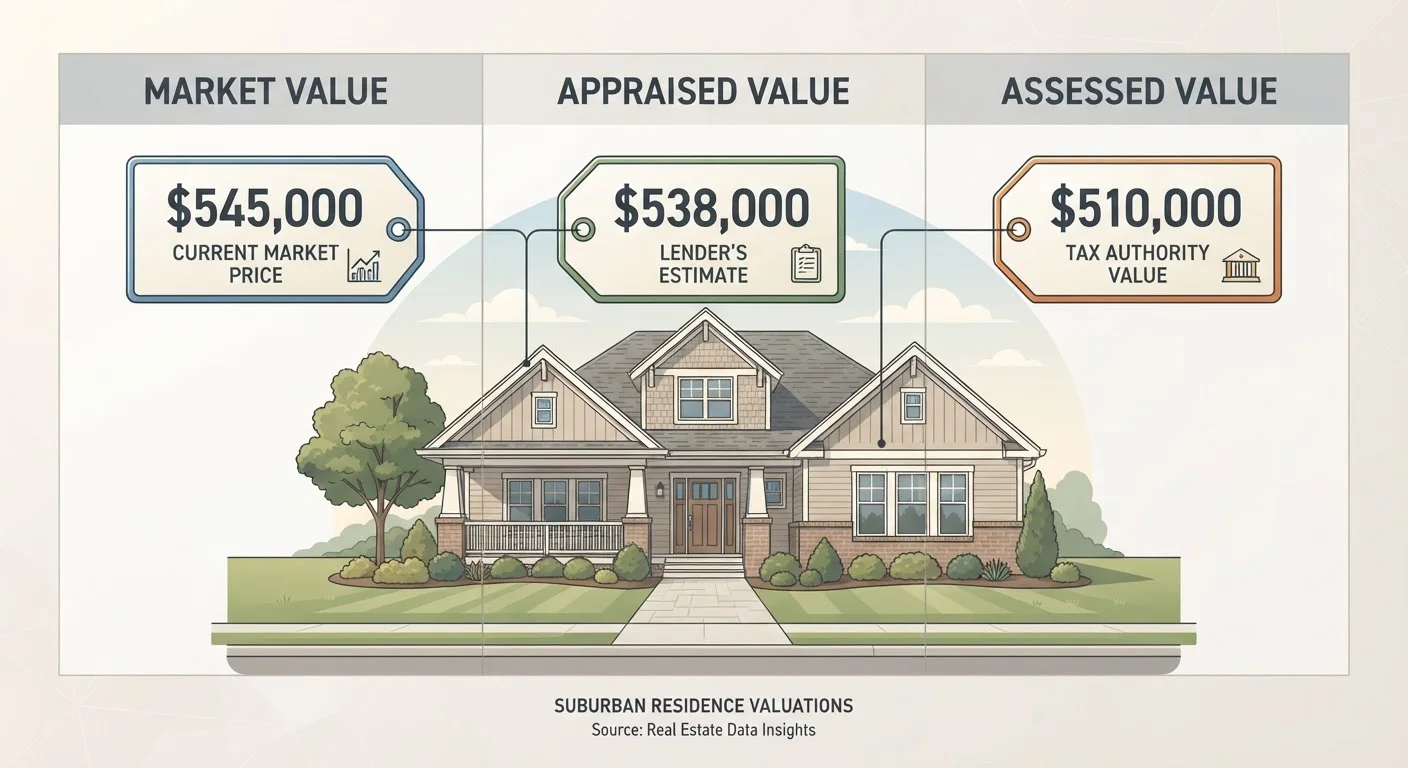
Photo: AdvisorBooth.net editorial
Why the Same Home Has Three Different Values
If you've ever looked up a home and seen a tax bill, a lender's appraisal, and a listing price that all land in different places, you're not being misled - you're seeing three distinct valuation systems doing exactly what they were designed to do. Each value is calculated by a different party, for a different purpose, using different data.
Understanding which number applies to your situation - buying, selling, borrowing, or appealing a tax bill - helps you interpret real estate data accurately rather than treating every figure as interchangeable. See our comprehensive property valuation guide for a broader look at how all these methods connect.
Assessed Value: The Tax Authority's Figure
Assessed value is the dollar amount a local government assigns to a property for the purpose of calculating property taxes. It is determined by a county or municipal assessor using mass-appraisal models - formulas applied uniformly across thousands of properties rather than individual inspections.
In many jurisdictions, assessed value is set as a percentage of estimated market value, sometimes called an assessment ratio. A home with an estimated market value of $400,000 in a jurisdiction with an 80% assessment ratio would carry an assessed value of $320,000. That assessed value is then multiplied by the local mill rate (tax rate) to produce the annual property tax bill.
Key points to understand about assessed value:
- It is recalculated on the assessor's schedule - often annually, but sometimes every few years - not in real time with market shifts.
- It can lag behind or overshoot actual market conditions depending on how recently the reassessment occurred.
- Property owners who believe their assessed value is inaccurate can file a formal appeal with the local assessor's office.
Appraised Value: The Lender's Benchmark
Appraised value is the professional opinion of a licensed or certified appraiser, typically commissioned by a mortgage lender before approving a home loan. Its primary function is to protect the lender: if a borrower defaults, the lender needs confidence that the collateral (the home) is worth at least as much as the loan amount.
Appraisers use several methods - most commonly the sales comparison approach, which benchmarks the subject property against recent sales of comparable homes (comps) in the same area. Factors examined include square footage, condition, lot size, location, and amenities. For a detailed look at this process, see how appraisals differ from home inspections and our full guide on how home appraisals actually work.
An appraised value that comes in below the agreed purchase price - a so-called low appraisal - can require renegotiation of the sale price or a larger down payment from the buyer. The appraisal is a snapshot tied to a specific date and purpose, not a permanent declaration of worth.
Market Value: What Buyers and Sellers Agree On
Market value - sometimes called fair market value - is the price a willing, informed buyer and a willing, informed seller would agree on in an open, competitive market, with neither party under pressure to act. It is not assigned by any authority; it emerges from real transactions.
Market value is highly dynamic. It shifts with interest rates, local inventory levels, neighborhood demand, and broader economic conditions. In a seller's market with low inventory, homes may transact well above their appraised value. In a buyer's market, the reverse can apply. The relationship between market conditions and property prices is a key concept for interpreting any value you see.
Listing prices are sellers' expectations of market value - not market value itself. The actual market value of a specific home is only truly confirmed when a sale closes. Automated estimate tools can approximate it, but as explored in our analysis of automated valuation models, they carry notable limitations.
This article is for general informational purposes only and does not constitute legal, financial, or tax advice. Consult a qualified real estate professional, licensed appraiser, or tax adviser for guidance specific to your situation.
The content on this site is for informational purposes only and is not a substitute for professional advice. Always consult a qualified professional for guidance specific to your situation.