
Fixed-Rate vs. Adjustable-Rate Mortgages: Understanding the Trade-Offs

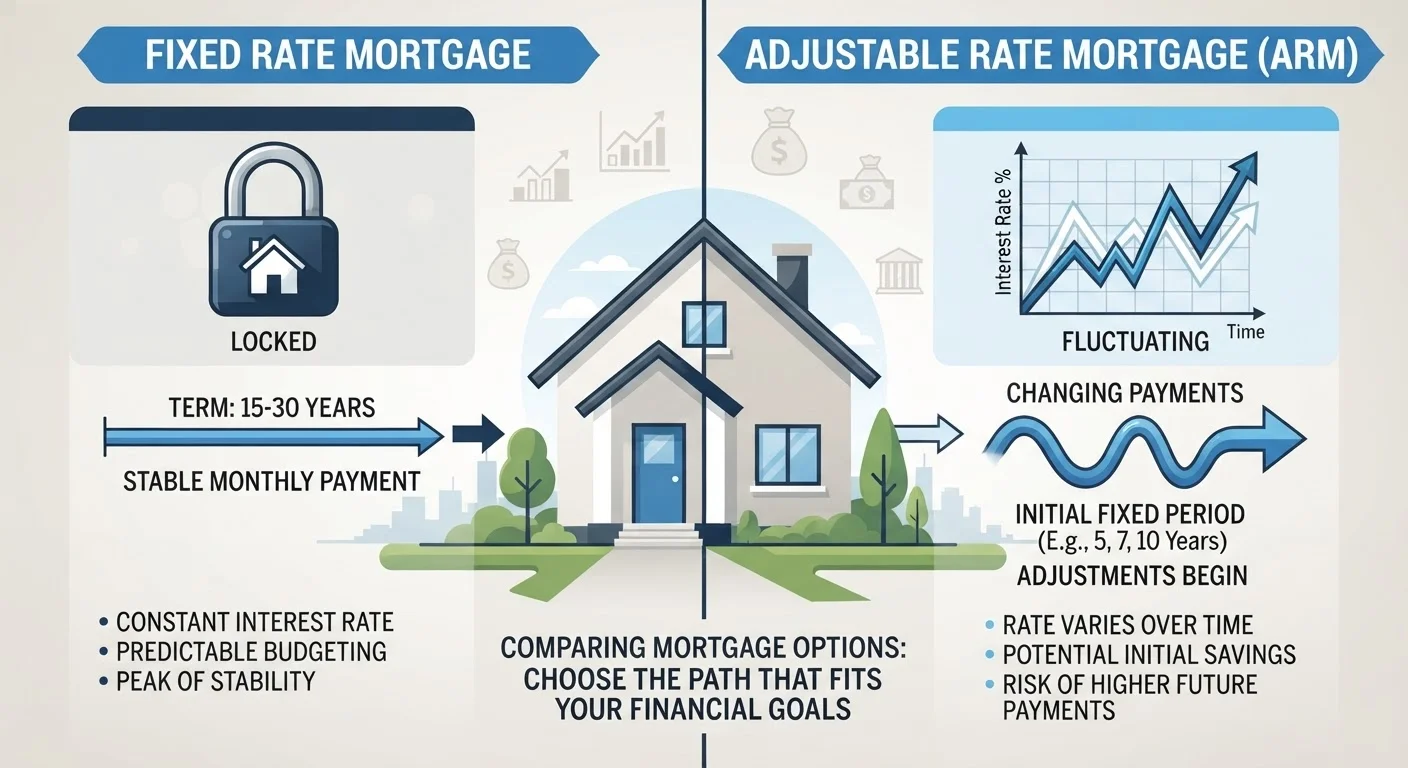
Photo: AdvisorBooth.net editorial
Key Takeaways
- Fixed-rate mortgages lock in your interest rate for the entire loan term, offering payment stability.
- Adjustable-rate mortgages start with a lower introductory rate that resets periodically based on a market index.
- ARMs carry rate-change risk after the initial fixed period ends, which can significantly raise monthly payments.
- Your expected time in the home is one of the most important factors in choosing between these two loan types.
- Both loan types are available in conventional and government-backed forms, affecting who qualifies and at what cost.
- Consulting a licensed mortgage professional is essential before committing to either structure.
How Each Mortgage Type Works
A fixed-rate mortgage carries an interest rate that never changes over the life of the loan - whether that's 15 or 30 years. Your principal and interest payment stays the same every month, making budgeting straightforward. The rate you lock in at closing is the rate you'll pay on your final payment.
An adjustable-rate mortgage (ARM) works differently. It begins with a fixed introductory period - commonly 5, 7, or 10 years - during which the rate is typically lower than prevailing fixed rates. After that period ends, the rate adjusts periodically (often annually) based on a benchmark index, such as the Secured Overnight Financing Rate (SOFR), plus a set margin determined by the lender. Caps limit how much the rate can rise per adjustment and over the life of the loan, but monthly payments can still climb meaningfully.
For context on how credit scores shape the rates you're offered on either loan type, see how credit scores affect mortgage terms.
| Criterion | Fixed-Rate Mortgage | Adjustable-Rate Mortgage (ARM) |
|---|---|---|
| Interest rate over time | Stays constant throughout the loan | Fixed initially, then adjusts periodically |
| Initial rate | Typically higher than ARM intro rate | Usually lower during introductory period |
| Payment predictability | Fully predictable - same every month | Predictable during fixed period; variable after |
| Rate-change risk | None | Present after fixed period ends |
| Typical fixed period | 15 or 30 years | 5, 7, or 10 years before first adjustment |
| Best horizon | Long-term homeowners (10+ years) | Short- to mid-term owners (under 7-10 years) |
| Rate cap protections | Not applicable | Per-adjustment and lifetime caps apply |
The Core Trade-Off: Certainty vs. Initial Cost
The fundamental tension between these two products is predictability versus upfront affordability. Fixed-rate mortgages generally carry a higher initial rate than ARMs because lenders price in the risk of holding a fixed rate over many years. That premium buys you insurance against rising rates - but you pay for it even if rates fall.
ARMs transfer some of that rate risk back to the borrower. In exchange, the lender offers a lower starting rate. If you sell or refinance before the fixed period expires, you may never experience a rate adjustment at all. But if circumstances change and you stay longer than planned, you're exposed to rate increases outside your control.
~70%
Share of US mortgages that are fixed-rate
Fixed-rate loans have historically dominated US mortgage originations, according to data from the Mortgage Bankers Association, particularly after periods of rate volatility.
5/1 ARM
Most common ARM structure in the US
The 5/1 ARM - fixed for five years, then adjusting annually - is among the most widely used ARM products, per the Consumer Financial Protection Bureau's mortgage market reports.
2%/5%
Typical ARM adjustment caps (periodic/lifetime)
Most ARMs include a periodic cap limiting each rate change and a lifetime cap limiting total rate movement; the CFPB notes 2% periodic and 5% lifetime caps are common structures.
Broader economic forces - including Federal Reserve policy and housing supply - directly influence what rates are available at any given time. Understanding those dynamics can inform your timing. The article supply, demand, and interest rates explains how these forces interact with home prices.
Key Factors That Should Shape Your Decision
No single mortgage structure is universally better. The right choice depends on several personal and market-related factors:
- How long you plan to stay: This is often the deciding factor. If your timeline is under seven years, an ARM's initial savings may outweigh the rate-adjustment risk. Longer timelines generally favor fixed rates.
- Your risk tolerance: Some borrowers find it difficult to manage financial uncertainty. If the possibility of a higher payment in year six creates anxiety, a fixed rate provides peace of mind that has real value.
- Current rate environment: When fixed rates are historically low, locking in makes more sense. When fixed rates are elevated, an ARM's initial discount may be more attractive - particularly if rates are expected to fall.
- Income trajectory: Borrowers confident in rising income may be more comfortable absorbing potential ARM adjustments. Those on fixed or unpredictable incomes should weigh this carefully.
- Loan type eligibility: Both ARMs and fixed-rate loans are available through conventional, FHA, VA, and USDA programs. Understanding how those programs compare can clarify which loan types are available to you.
ARM Rate Caps: What They Mean in Practice
This article is for general informational purposes only and does not constitute financial or mortgage advice. Consult a licensed mortgage professional before making decisions about loan products.
The content on this site is for informational purposes only and is not a substitute for professional advice. Always consult a qualified professional for guidance specific to your situation.