
What Compound Interest Actually Does to Your Savings Over Time

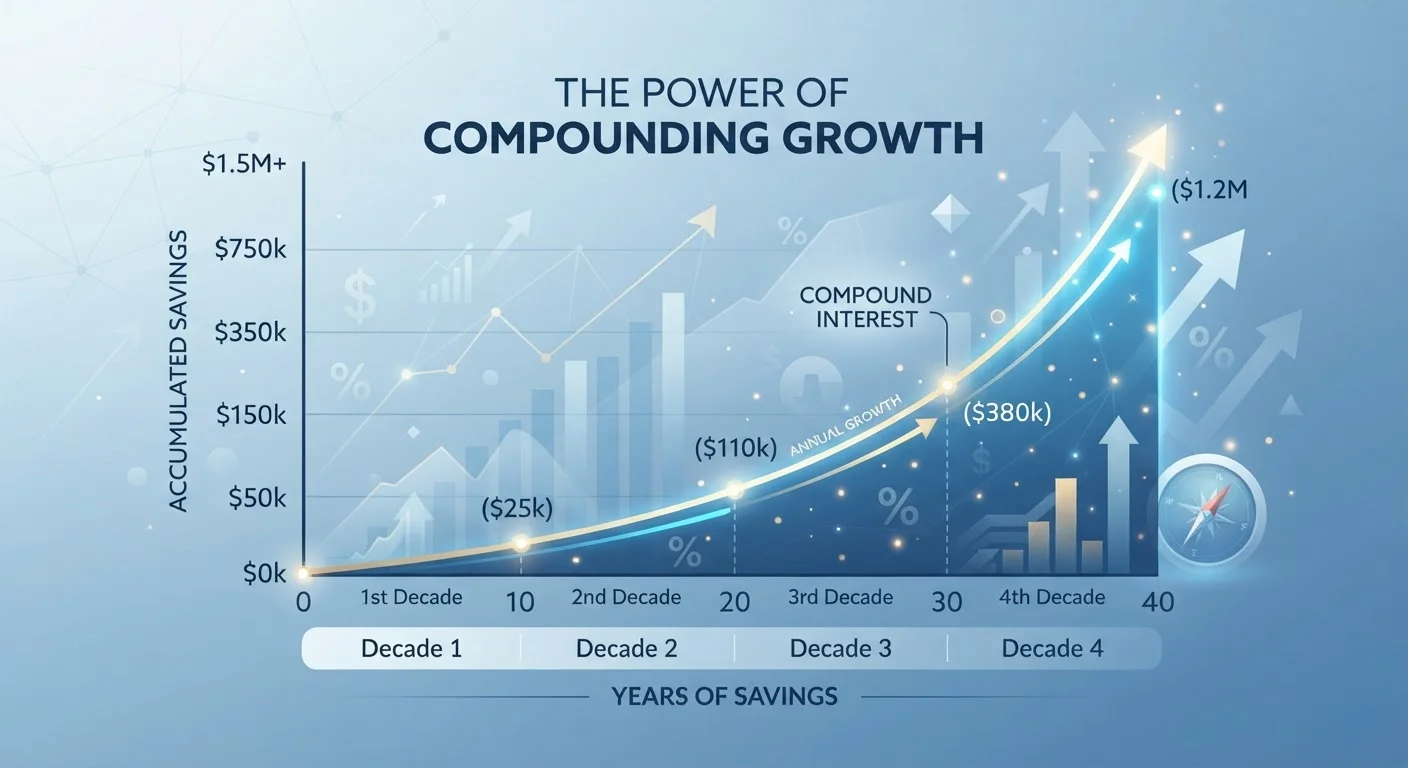
Photo: AdvisorBooth.net editorial
Key Takeaways
- Compound interest earns returns on both your principal and previously accumulated interest.
- Time is the most powerful variable - starting earlier dramatically amplifies long-term results.
- Compounding frequency (daily vs. monthly) affects how quickly interest accumulates.
- High-interest debt uses the same compounding mechanism against you.
- Even small, consistent contributions benefit enormously from long compounding periods.
The Basic Mechanics: How Compounding Actually Works
At its core, compound interest is interest earning interest. When you deposit money into a savings account, the account pays you a percentage of your balance as interest. With simple interest, that payment is always calculated on your original deposit. With compound interest, each new interest payment gets added to your running balance - and the next calculation uses that larger number.
Here's a concrete illustration: Deposit $5,000 at a 5% annual rate. After year one, you earn $250, bringing your balance to $5,250. In year two, you earn 5% of $5,250 - not $5,000 - which is $262.50. By year three, you're earning interest on $5,512.50. The amounts seem small early on, but the trajectory bends upward over time.
This acceleration is what makes compounding distinctive. It isn't linear growth - it's exponential. And the longer the timeline, the more pronounced the curve becomes.
72
Years to double money at 1% - Rule of 72
The Rule of 72 estimates doubling time by dividing 72 by the interest rate; at 6%, money doubles in roughly 12 years.
~10x
Growth of $10,000 over 40 years at 6%
At a 6% annual compound rate, $10,000 grows to approximately $102,857 over 40 years with no additional contributions.
Daily
Compounding frequency of most savings accounts
Many bank savings accounts compound interest daily, meaning even small balances benefit from more frequent reinvestment cycles.
Why Timing Is the Most Powerful Variable
The biggest driver of compound interest isn't the interest rate - it's time. Starting earlier gives your money more compounding cycles, which is why financial educators consistently emphasize beginning to save as soon as possible, even in modest amounts.
Consider two savers. The first starts at age 25, contributing $200 per month at a 6% average annual return, and stops contributing at 45 - a 20-year window. The second starts at 45 and contributes the same $200 monthly until age 65, also a 20-year window. Despite identical contribution amounts and the same rate, the first saver ends up with a considerably larger balance at retirement, simply because their money had more time to compound.
For a deeper look at how time horizon shapes investment outcomes, see how time horizon shapes every investment decision.
Use the Rule of 72 for Quick Estimates
Compounding Works Both Ways: The Debt Side of the Equation
The same mechanism that builds savings can also erode financial stability when it applies to debt. Credit card balances, for instance, typically carry high interest rates that compound - often daily. When you carry a balance, the interest you owe is added to your principal, and the next billing cycle charges interest on the new, higher total.
This dynamic is why a relatively modest unpaid balance can grow faster than expected. A $3,000 credit card balance at 22% APR, carried for several years with only minimum payments, can cost significantly more in interest than the original purchase.
Understanding this symmetry helps explain why the decision of whether to prioritize debt repayment or savings is genuinely complex. Our explainer on the debt-first vs. savings-first dilemma walks through the trade-offs and math behind each approach.
Putting It to Work: Practical Implications for Savers
Understanding compound interest changes how you think about savings decisions. A few principles worth keeping in mind:
- Frequency of compounding matters at the margin. When comparing accounts, an account that compounds daily will outperform one compounding annually at the same stated rate - though the difference is modest and rate level usually matters more.
- Consistent contributions amplify the effect. Each new deposit starts its own compounding clock. Regular contributions, even small ones, meaningfully increase the compounding base over time.
- Withdrawals interrupt the cycle. Every withdrawal removes money that would otherwise have continued compounding. This doesn't mean you should never access savings - but it illustrates why long-term accounts benefit from being left undisturbed.
For practical strategies that align with these principles, savings strategies with long-run staying power offers evidence-based habits worth considering.
This article is for general informational and educational purposes only and does not constitute personalized financial, investment, or tax advice. Consult a qualified financial professional before making decisions based on your individual circumstances.
Frequently Asked Questions
The content on this site is for informational purposes only and is not a substitute for professional advice. Always consult a qualified professional for guidance specific to your situation.