
The Debt-First vs. Savings-First Dilemma, Explained

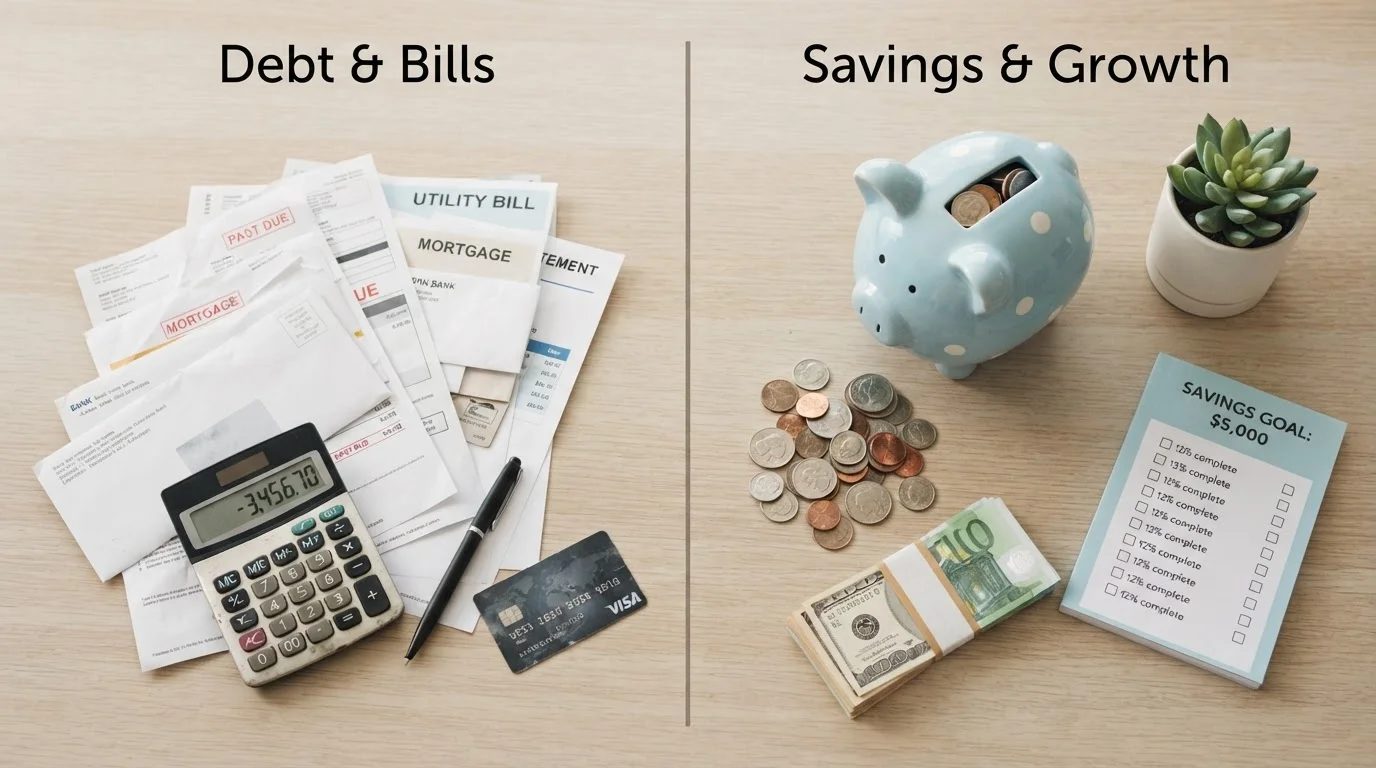
Photo: AdvisorBooth.net editorial
Key Takeaways
- High-interest debt almost always costs more than savings accounts earn, making debt payoff mathematically efficient.
- A small emergency fund - even $500-$1,000 - can prevent new debt from forming when unexpected costs arise.
- Employer 401(k) matching is often worth capturing even while carrying debt, because it represents an immediate return on contributed dollars.
- Low-interest debt, like certain student loans or mortgages, may justify building savings and investing simultaneously.
- Most financial situations benefit from a hybrid approach rather than an all-or-nothing strategy.
- Your personal risk tolerance and financial stability are just as important as the math when making this decision.
Why the Question Exists
Every extra dollar in your budget faces a fork in the road: send it toward an outstanding balance, or set it aside for future needs. Both choices have real financial merit, and neither is automatically wrong. The dilemma persists because most households carry some form of debt while also needing financial reserves - making this a genuine trade-off, not a simple calculation.
The stakes are meaningful. Pay debt too slowly, and interest charges compound quietly in the background, costing you real money over time. Save too little, and a car repair or medical bill can force you right back into debt, undoing the progress you made. Understanding the mechanics behind each option is the foundation for making a decision that fits your actual situation.
For a broader look at how debt and savings interact across your financial life, see the end-to-end financial roadmap that covers the full arc of personal financial health.
The Math Behind Debt Payoff
Paying down debt is one of the few places in personal finance where you can earn a guaranteed, risk-free return. If you carry a credit card balance at 20% annual interest, every dollar applied to that balance effectively returns 20% - because you're eliminating a guaranteed cost, not chasing a variable market gain.
That matters because most savings vehicles - high-yield savings accounts, CDs, money market accounts - rarely match high-interest debt rates over sustained periods. The result: when debt interest rates are high, paying them down first is typically the more efficient use of money, purely on a numbers basis.
20%+
Average credit card interest rate in the U.S.
The Federal Reserve has tracked average credit card rates above 20% APR in recent reporting periods, making revolving balances among the most expensive common forms of consumer debt.
~40%
Americans who carry credit card debt month to month
Federal Reserve surveys consistently show roughly four in ten U.S. adults carry a balance on at least one credit card, meaning interest charges accrue regularly for a large share of households.
3-6 months
Recommended emergency fund coverage
Most mainstream personal finance guidance suggests building reserves covering three to six months of essential living expenses, though individual circumstances vary widely.
Of course, math alone doesn't account for liquidity. Applying every available dollar to debt can leave you without cash reserves, which creates its own vulnerability. That's why understanding the emergency fund vs. debt payoff trade-off is a critical companion to this decision.
The Case for Building Savings First
The strongest argument for savings-first is financial resilience. Without a cushion, any surprise expense - a job disruption, a medical bill, a home repair - becomes a potential debt event. A small emergency fund breaks this cycle by giving you a buffer before reaching for credit.
Beyond emergencies, there are specific savings goals that carry their own logic. Employer-sponsored retirement plans with matching contributions effectively offer an immediate return on your contributed dollars - a distinct advantage that debt payoff cannot replicate. Forgoing that match to pay down low-interest debt may not be mathematically sound.
Don't Skip the Employer Match
Savings also matter when your debt carries a relatively low interest rate. A mortgage at 3.5% or a subsidized student loan at 4% may not warrant aggressive prepayment when alternative uses of those dollars - investing, retirement contributions - could reasonably outperform that rate over a long time horizon, though investing always involves risk and no return is guaranteed. For more on how time affects these decisions, see how time horizon shapes every investing decision.
A Practical Framework for Most People
Rather than choosing one path absolutely, most financial planning frameworks recommend a sequenced, hybrid approach:
- Build a starter emergency fund - typically $500-$1,000 - before aggressively targeting debt. This prevents small setbacks from creating new borrowing.
- Capture any employer retirement match - this is often the highest-return financial move available, regardless of debt status.
- Attack high-interest debt aggressively - credit cards and personal loans above roughly 6-7% interest are expensive enough to deserve focused payoff. See avalanche vs. snowball methods for structured repayment strategies.
- Balance savings and low-interest debt - once high-cost debt is cleared, you can begin growing savings more meaningfully alongside any remaining low-rate obligations.
This sequence isn't universal - individual income, debt loads, and risk tolerance all shift the math. If you're working through this with significant complexity, consulting a licensed financial adviser is worthwhile. Also consider starting a savings habit from zero if reserves are currently nonexistent.
Behavioral Factors That Shift the Decision
Numbers explain a lot - but they don't explain everything. The emotional weight of carrying debt affects people differently. For some, eliminating a high balance provides a sense of control and forward momentum that motivates continued financial discipline. For others, seeing savings grow provides psychological security that makes it easier to stay on a plan.
Neither reaction is irrational. Behavioral factors like these are real inputs into a sustainable strategy. A plan you'll actually follow outperforms a mathematically optimal plan you abandon after two months.
It's also worth recognizing structural factors that can make this dilemma harder - income volatility, limited credit access, and cyclical debt patterns all affect how realistically someone can execute a textbook strategy. For context on why debt can be genuinely difficult to exit, see why people stay in debt despite wanting out.
This article is for general informational and educational purposes only and does not constitute personalized financial, investment, tax, or legal advice. Consult a qualified financial professional before making decisions specific to your circumstances.
Frequently Asked Questions
The content on this site is for informational purposes only and is not a substitute for professional advice. Always consult a qualified professional for guidance specific to your situation.