
Hands-Free vs. Handheld Phone Use While Driving: Is One Actually Safer?

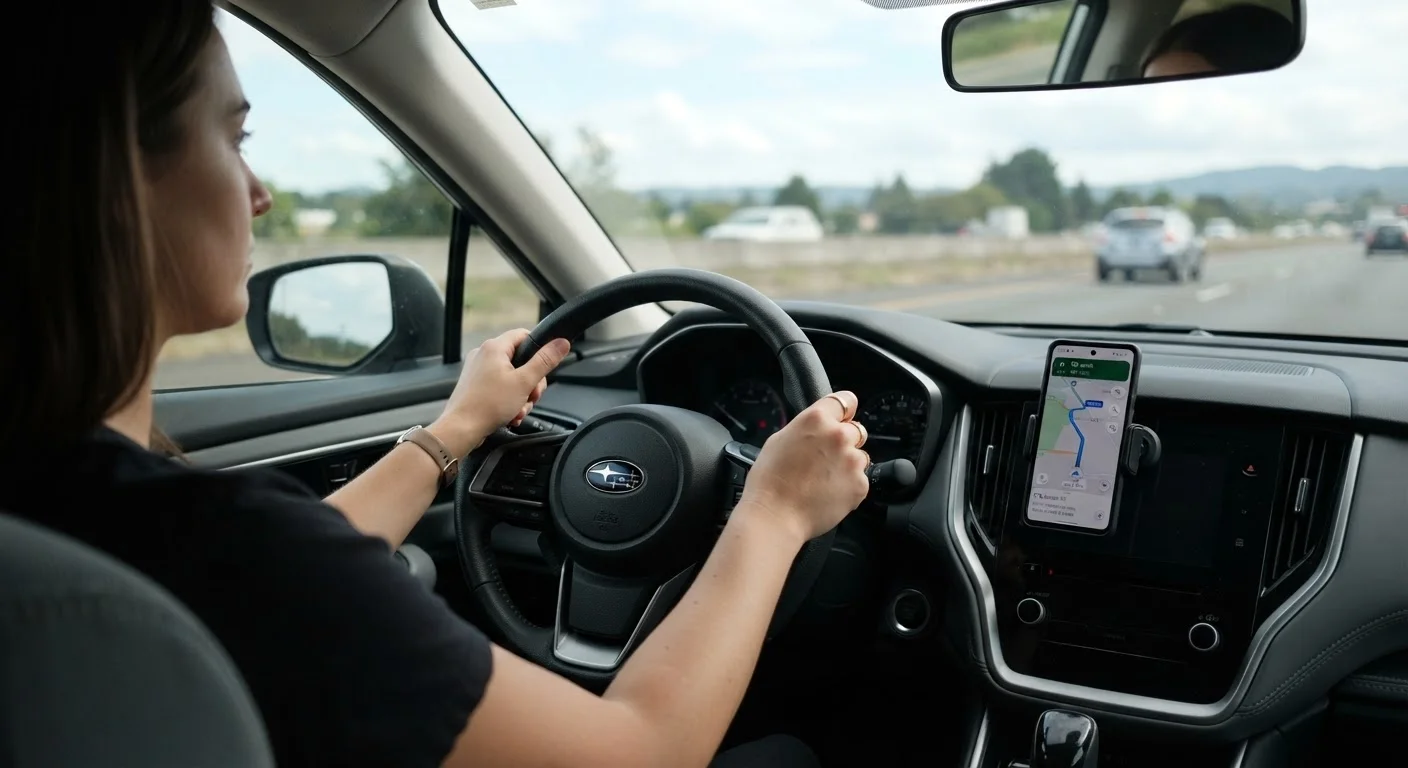
Photo: AdvisorBooth.net editorial
Key Takeaways
- Handheld phone use while driving is illegal in many U.S. states and significantly raises crash risk.
- Hands-free calls still impose substantial cognitive distraction, even though both hands remain on the wheel.
- Research from the National Safety Council indicates hands-free calling is not risk-free behind the wheel.
- The safest option is to avoid all phone conversations while driving, regardless of the device setup.
- Laws vary widely by state - compliance with local regulations does not equal full safety.
How Distraction Actually Works Behind the Wheel
Traffic safety researchers typically describe driver distraction in three categories: visual (eyes off the road), manual (hands off the wheel), and cognitive (mind off the task of driving). Handheld phone use triggers all three simultaneously. Hands-free use eliminates the first two - but leaves the third fully intact.
This distinction matters more than most drivers realize. Cognitive distraction causes a phenomenon sometimes called "inattention blindness," where a driver's eyes are pointed forward but their brain is not fully processing what they see. Studies cited by the National Safety Council have found that drivers using any type of phone conversation can miss a meaningful portion of the visual cues in front of them, even with both eyes open and both hands on the wheel.
For a deeper look at how attention fragments during everyday driving tasks, see Distracted Driving by the Numbers.
| Criterion | Hands-Free Phone Use | Handheld Phone Use |
|---|---|---|
| Hands on wheel | Yes - both hands free | No - one hand occupied |
| Eyes on road | Generally yes | Often diverted |
| Cognitive distraction | Significant - still present | Significant - compounded |
| Legal status (most U.S. states) | Permitted for adult drivers | Banned or restricted |
| Crash risk vs. no phone | Elevated above baseline | Substantially elevated |
| Reaction time impact | Measurably slowed | Significantly slowed |
What the Research Says About Crash Risk
The evidence against handheld use is well-established. The National Highway Traffic Safety Administration (NHTSA) has long documented that manipulating a phone - dialing, texting, or holding it to your ear - creates measurable reaction-time delays and sharply increases the probability of a crash or near-crash event.
Hands-free calling presents a more nuanced picture. Multiple peer-reviewed studies, including research published by the AAA Foundation for Traffic Safety, have found that voice-based conversations - even through a Bluetooth system or vehicle-integrated interface - still significantly impair driving performance compared to no conversation at all. The act of formulating and processing language competes directly with the brain's resources needed for hazard detection.
4x
Increased crash risk with handheld phone use
NHTSA and multiple traffic safety studies have consistently associated handheld phone use with roughly four times the crash risk of undistracted driving.
~27%
Reduction in brain activity processing driving
Research from Carnegie Mellon University found that listening to someone speak on a phone reduced driving-related brain processing by approximately 37%, illustrating cognitive load even without physical distraction.
2-3x
Crash risk elevation with hands-free calls
The AAA Foundation for Traffic Safety has reported that hands-free phone calls can still elevate crash risk two to three times above baseline undistracted driving.
Notably, talking with a passenger in the car tends to be less cognitively disruptive than a phone call. Passengers naturally moderate the conversation based on driving conditions - they go quiet in heavy traffic or when a hazard appears. A caller on the other end of the phone has no awareness of your road environment and keeps the cognitive demand constant regardless of what's happening around you.
The Legal Landscape Across the U.S.
From a legal standpoint, handheld and hands-free phone use are treated very differently. As of recent years, a majority of U.S. states have enacted laws banning handheld phone use for all drivers, and many jurisdictions impose stricter rules for teen or commercial drivers. Texting bans are even more widespread.
Hands-free use, by contrast, is permitted in nearly every state - though some localities have gone further with restrictions. It is important to understand that legal permissibility is not the same as safety. Laws reflect what can be enforced and what represents a floor of acceptable behavior, not a ceiling of what is actually safe.
The variation in road types also plays a role. Demanding driving environments - dense urban intersections, highway merges, or adverse weather - require more cognitive bandwidth, leaving less capacity to absorb even the relatively lower distraction of a hands-free call. For a breakdown of how driving demands shift by environment, see Highway Driving vs. City Driving.
This article provides general educational information about driver distraction and phone use. It is not legal advice. Laws vary by state and locality - always verify the rules that apply in your jurisdiction.
The content on this site is for informational purposes only and is not a substitute for professional advice. Always consult a qualified professional for guidance specific to your situation.