
Month-to-Month vs. Fixed-Term Lease: Which Arrangement Fits Your Situation

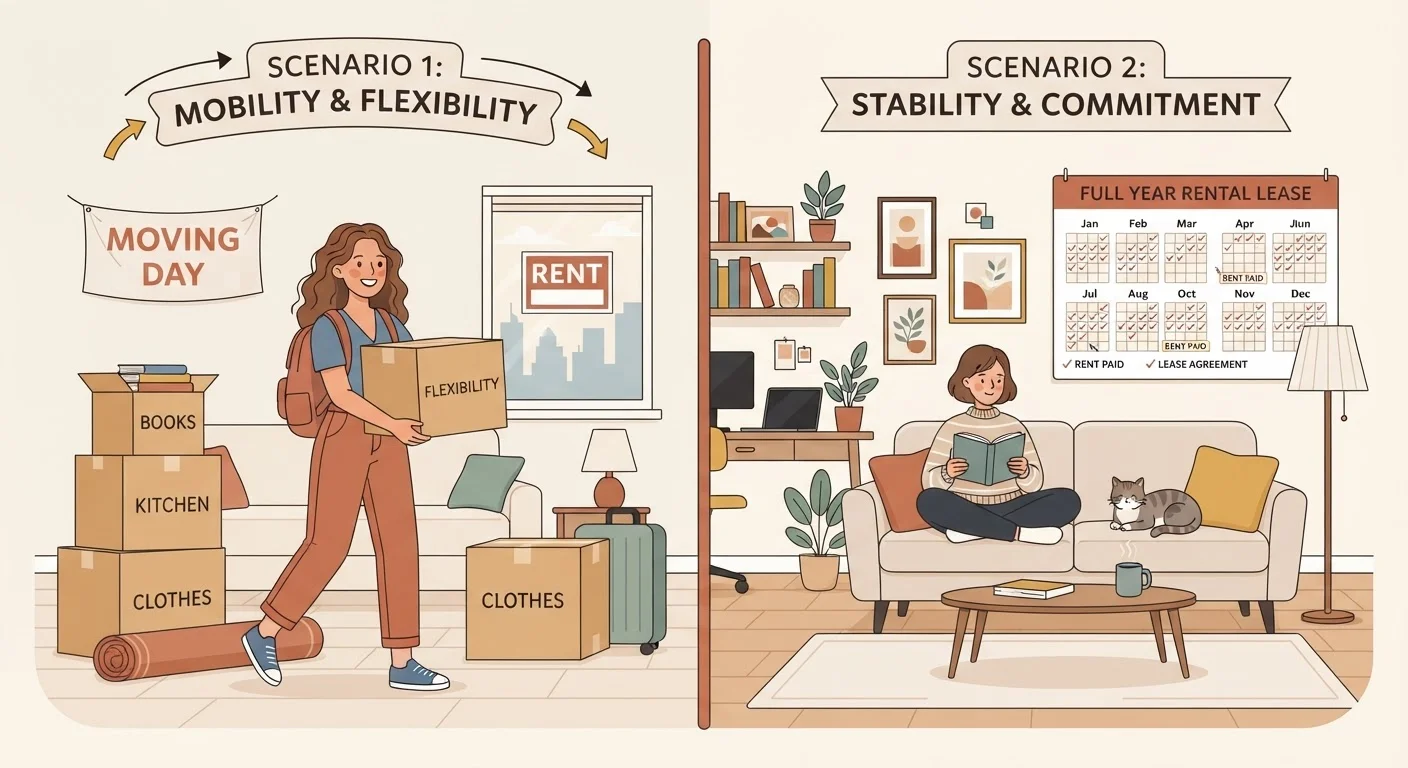
Photo: AdvisorBooth.net editorial
Key Takeaways
- Month-to-month leases typically allow either party to end the tenancy with 30 days' notice, but state laws vary.
- Fixed-term leases lock in your rent and terms for the lease period, protecting you from mid-year increases.
- Landlords often charge a premium - sometimes 10-25% more per month - for the flexibility of a month-to-month arrangement.
- Breaking a fixed-term lease early can trigger fees, forfeited deposits, or liability for remaining rent.
- Your state's landlord-tenant law governs notice requirements, termination rights, and allowable fees for both lease types.
- Neither lease type is universally better - the right choice depends on your housing timeline and financial situation.
How Each Lease Type Works
A month-to-month lease (also called a periodic tenancy) automatically renews each month until either the landlord or tenant provides written notice to terminate. Most states require 30 days' notice, though some jurisdictions mandate longer periods - California, for example, requires 60 days' notice from landlords if the tenant has lived in the unit for more than a year. Because the agreement renews continuously, the landlord can also adjust rent or terms with proper notice, subject to local rent-control ordinances. See our guide on rent-controlled vs. market-rate apartments for detail on how local policy can limit those adjustments.
A fixed-term lease is a contract binding both parties for a set period - most commonly 12 months, though 6-month and 24-month terms exist. The rent amount and lease conditions are locked in for the full term. Once signed, a landlord generally cannot raise rent or change material terms until the lease expires, and a tenant cannot vacate without consequence before the end date unless the lease or state law provides a specific exit right (such as military deployment under the federal Servicemembers Civil Relief Act).
| Criterion | Month-to-Month Lease | Fixed-Term Lease |
|---|---|---|
| Lease duration | Renews automatically each month | Set period, typically 12 months |
| Monthly rent | Often 10-25% higher | Locked in for the full term |
| Notice to vacate | 30-60 days (varies by state) | Must wait for lease end date |
| Rent increase risk | Any month, with proper notice | None until lease expires |
| Early exit cost | Minimal (notice period only) | Fees or remaining rent liability |
| Displacement risk | Higher - landlord can end tenancy | Lower during lease term |
| Best for | Uncertain timelines, transitions | Stable plans, budget certainty |
The Real Cost of Flexibility
Month-to-month arrangements almost always carry a higher monthly rent than equivalent fixed-term units. Landlords price in the risk of vacancy: if you leave next month, they need to re-list immediately. The premium varies widely by market and landlord, but it can meaningfully affect your annual housing budget.
10-25%
Typical month-to-month rent premium
Industry estimates suggest month-to-month tenants commonly pay a meaningful premium over equivalent fixed-term renters, though the range varies widely by market and landlord.
30-60 days
Standard notice period required
Most US states require 30 days' written notice to end a month-to-month tenancy; some, like California, require 60 days for tenants who have resided in a unit over one year.
1-2 months
Typical early termination fee
Early termination clauses in fixed-term leases commonly require payment of one to two months' rent, though the exact amount depends on the lease and applicable state law.
Beyond monthly rent, consider the less obvious costs on both sides. Breaking a fixed-term lease early often triggers an early termination clause - commonly one to two months' rent - or, in states that allow it, liability for the remaining lease balance until the unit is re-rented. Many states legally require landlords to make reasonable efforts to re-rent (known as the duty to mitigate), but the burden of proving they didn't can fall on the departing tenant. If you're uncertain whether you'll complete a full lease term, that risk exposure is a genuine financial liability, not just a paperwork inconvenience.
On the other side, month-to-month tenants can also face abrupt displacement. A landlord can end a periodic tenancy with proper notice - which may be less than two months - making long-term stability harder to plan around. In high-demand rental markets, this can mean being forced out when comparable units are scarce or significantly more expensive.
Legal Protections and Notice Requirements
Both lease types are governed by state landlord-tenant law, which varies considerably across the country. A few key legal distinctions are worth understanding before you sign:
- Notice to vacate: Month-to-month tenants typically receive 30 days' notice (or 60 days in some states for long-term tenants). Fixed-term tenants generally have occupancy guaranteed through the end of the lease term, unless they've violated the lease agreement.
- Rent increases: On a month-to-month lease, rent can typically be raised with proper advance notice (usually 30 days). On a fixed-term lease, rent cannot increase until the contract expires - unless the lease itself includes an escalation clause, which you should review carefully before signing.
- Security deposit rules: Deposit limits, return timelines, and allowable deductions are set by state law and apply equally to both lease types. Always get a written move-in inspection report.
If you're sharing a unit with others, the lease structure also affects shared liability. Our article on joint leases and roommate liability explains how co-signers on either lease type can be held responsible for one another's obligations.
Know Your State's Specific Rules
If you're considering subletting during a fixed-term lease, that right depends on what your lease says and your state's law. Our overview of subletting vs. lease assignment covers how those options differ and when each may apply.
Choosing the Right Structure for Your Situation
The decision comes down to two variables: your expected length of stay and your tolerance for rent variability. If your timeline is clear and extends at least 12 months, a fixed-term lease typically provides better financial predictability and protection. If your plans are genuinely uncertain - a job relocation is pending, you're evaluating neighborhoods before committing - the month-to-month premium may be worth paying to avoid early-termination exposure.
It's also worth asking whether your prospective landlord offers a lease conversion option: some landlords allow tenants to transition from a fixed-term to a month-to-month arrangement at the end of the initial term, sometimes at a slightly higher rate. Negotiating this in advance can give you the stability of a fixed term initially with the flexibility to pivot at renewal.
Finally, if you're weighing the economics of renting versus owning more broadly, the same fixed-versus-variable trade-off appears in mortgage structures. Our comparison of fixed-rate and adjustable-rate mortgages walks through how that parallel decision works for buyers.
This article provides general information about rental lease structures and is not legal advice. Landlord-tenant laws vary by state and locality. Consult a licensed attorney or local tenant rights organization for guidance specific to your situation.
The content on this site is for informational purposes only and is not a substitute for professional advice. Always consult a qualified professional for guidance specific to your situation.