
Insulation Types Compared: Fiberglass, Spray Foam, and Rigid Board

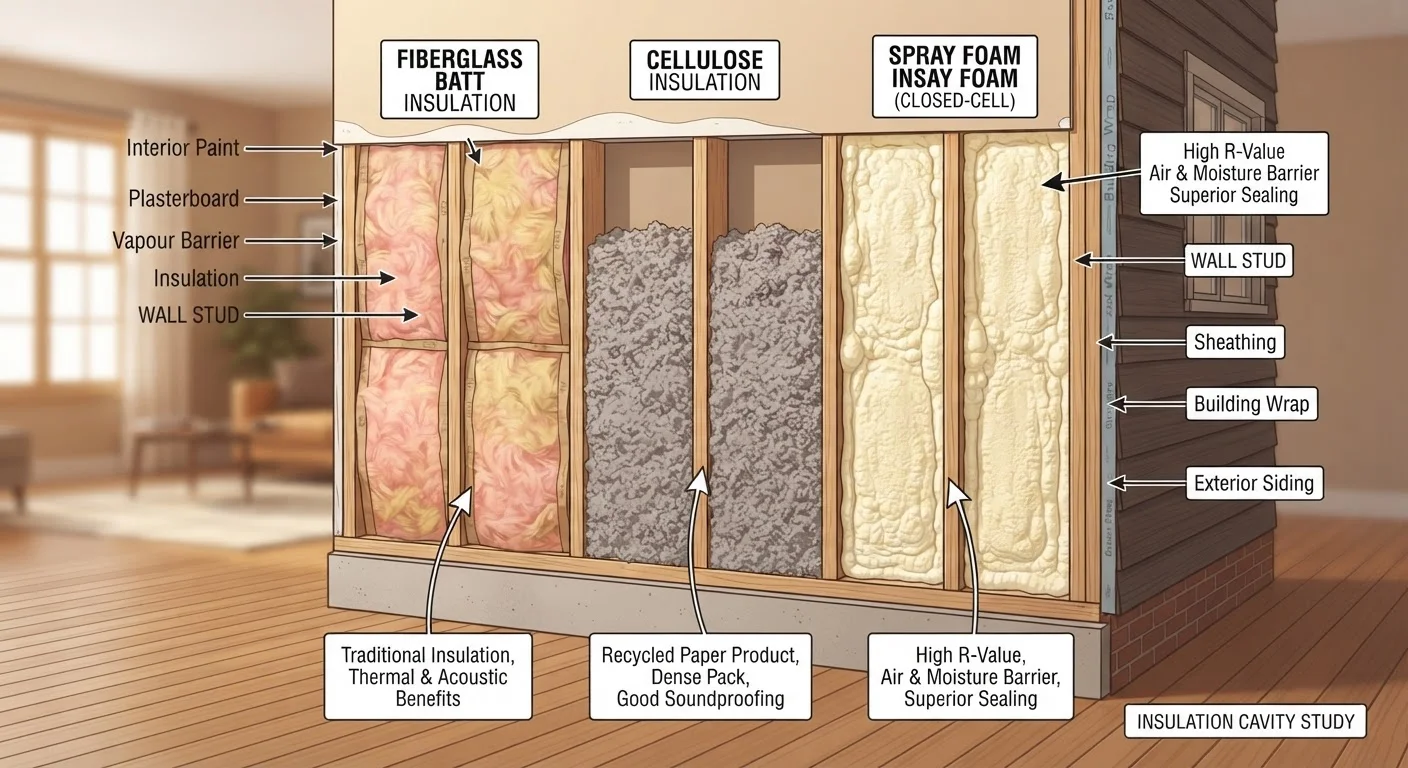
Photo: AdvisorBooth.net editorial
Key Takeaways
- Fiberglass batts are widely available and cost-effective, but leave gaps that reduce real-world performance.
- Spray foam offers the highest air-sealing benefit but requires professional installation and higher upfront cost.
- Rigid board insulation excels in tight spaces and exterior applications where moisture resistance matters.
- R-value alone doesn't tell the whole story - air sealing, moisture control, and installation quality all affect results.
- Combining insulation types in different zones of a home is a common and effective strategy.
Why Insulation Type Matters Beyond R-Value
Most homeowners know that insulation is measured in R-value - a rating of thermal resistance where higher numbers mean better performance. What's less understood is that installed R-value and labeled R-value often differ significantly. Air gaps, compression, moisture, and poor installation can all degrade how an insulation product actually performs in your walls, attic, or basement.
Choosing the right material means thinking about more than just the number on the label. Each insulation type has a distinct physical form, installation method, and set of strengths suited to specific parts of a home. Pairing the right material to the right application is how homeowners get the most value from their insulation investment. For a broader look at how insulation works alongside air sealing, see our guide to home weatherization.
Fiberglass Insulation: The Familiar Standard
Fiberglass is the most commonly installed insulation in American homes, available as pre-cut batts (blankets) or as loose-fill blown into attic cavities. It's made from fine glass fibers and is non-combustible, resistant to moisture damage when kept dry, and widely stocked at home improvement stores.
Where it works well: Standard 2×4 and 2×6 stud wall cavities, attic floors between joists, and cathedral ceilings with adequate ventilation space.
Key limitation: Fiberglass does not air-seal on its own. Air can move through and around batts freely, which means any gaps, compression, or misfit installation significantly reduces real-world performance. It works best when paired with a proper air barrier - something many DIY installations overlook.
| Fiberglass Batts | Spray Foam | Rigid Board | |
|---|---|---|---|
| Typical R-value per inch | R-2.9 to R-3.8 | R-3.5 (open) / R-6-7 (closed) | R-3.8 to R-6.5 |
| Air sealing ability | None on its own | Excellent - seals as it cures | Good with taped joints |
| Moisture resistance | Low - degrades when wet | High (closed-cell) | High (XPS and polyiso) |
| DIY-friendly | Yes, widely accessible | Limited - professional recommended | Yes, cut-and-fit panels |
| Relative cost | Lower upfront cost | Higher upfront cost | Moderate cost |
| Best application zone | Wall cavities, attic floors | Rim joists, crawl spaces | Exterior sheathing, below-grade |
Spray Foam Insulation: The Air-Sealing Champion
Spray polyurethane foam (SPF) is applied as a liquid that expands and hardens, forming both an insulating layer and an air barrier simultaneously. It comes in two forms: open-cell foam, which is softer, more flexible, and vapor-permeable; and closed-cell foam, which is denser, more rigid, and has a significantly higher R-value per inch (typically R-6 to R-7 versus R-3.5 for open-cell).
Where it works well: Rim joists, crawl space walls, attic roof decks (unvented assemblies), and any irregular cavity where batts would be difficult to fit without gaps.
Key limitation: Professional installation is generally required for full two-component spray foam systems, and costs are considerably higher than fiberglass. Some formulations also require occupants to vacate during application and a brief curing period afterward. DIY small-can foam is suitable only for spot-sealing cracks and gaps, not area insulation.
Combine Materials for the Best Results
Rigid Board Insulation: Versatile and Moisture-Resistant
Rigid foam boards - typically made from expanded polystyrene (EPS), extruded polystyrene (XPS), or polyisocyanurate (polyiso) - are manufactured panels that offer consistent, high R-value per inch in a thin, manageable profile. XPS and polyiso are particularly resistant to moisture absorption, making them well-suited for applications where contact with soil or water vapor is a concern.
Where it works well: Exterior wall sheathing (continuous insulation that eliminates thermal bridging through studs), basement walls, under concrete slabs, and in roof assemblies. Rigid board is also useful for adding insulation to the exterior of an existing wall without reducing interior space.
Key limitation: Rigid boards must be cut to fit precisely and joints must be taped or sealed to control air movement. Some polyiso products also see performance reduction in very cold temperatures, so material selection should account for climate zone. Most foam boards require a thermal barrier (such as drywall) when installed on interior surfaces, as they are combustible.
Choosing the Right Insulation for Each Location
Rather than thinking about insulation as an either/or decision, consider matching material to location:
- Attic floor: Blown fiberglass or cellulose works efficiently at achieving high R-values over large areas.
- Attic roof deck (unvented): Closed-cell spray foam or rigid board above deck is typically required to manage moisture in this assembly.
- Wall cavities: Fiberglass batts with a continuous rigid board layer on the exterior eliminates thermal bridging effectively.
- Basement walls: Rigid XPS or EPS handles moisture exposure; spray foam works well for sealing the rim joist zone above the foundation.
- Crawl spaces: Closed-cell spray foam or rigid board on the walls with a sealed vapor barrier on the floor is a common strategy.
Because every home has different construction details, climate considerations, and existing conditions, consulting a building performance professional or licensed insulation contractor before major insulation work is worthwhile. They can assess your specific assembly, check for moisture issues, and recommend the appropriate combination of materials and installation techniques.
This article provides general educational information about insulation materials and is not a substitute for professional evaluation of your specific home. Always verify local building codes and permit requirements before beginning insulation work.
The content on this site is for informational purposes only and is not a substitute for professional advice. Always consult a qualified professional for guidance specific to your situation.