
Financing Through a Dealership vs. Your Own Bank or Credit Union

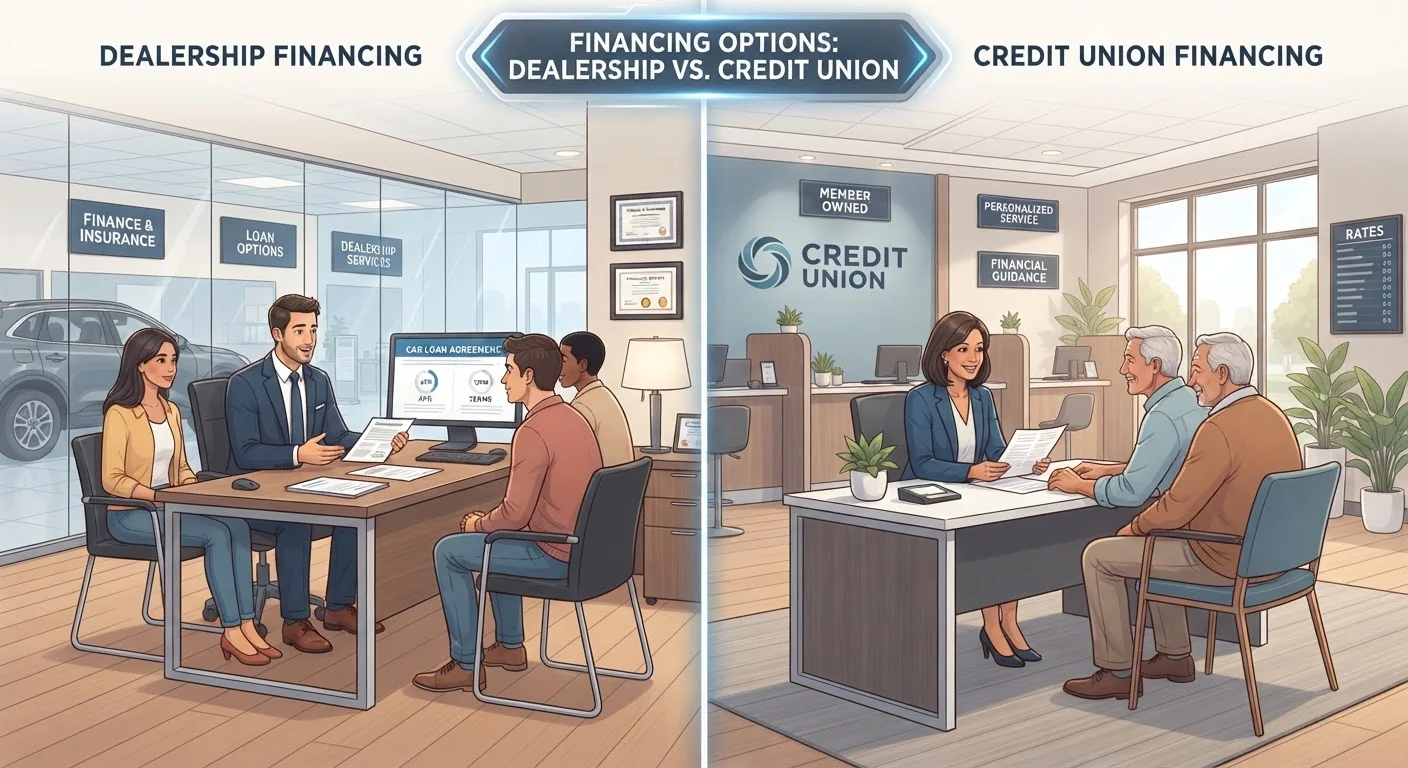
Photo: AdvisorBooth.net editorial
Key Takeaways
- Dealer financing is convenient but dealers may mark up the interest rate above what the lender actually requires.
- Getting pre-approved through your own bank or credit union gives you a baseline rate to compare before you negotiate.
- Credit unions often offer lower rates than banks and dealerships, especially for members with solid credit histories.
- Manufacturer-subsidized rates through dealerships can genuinely beat direct lending - but only on qualifying vehicles and buyers.
- Shopping multiple lenders within a short window typically counts as one hard inquiry on your credit report.
- The financing channel is a separate negotiation from the vehicle price - treat them independently.
How Each Financing Path Actually Works
Understanding the mechanics of each option helps you spot the differences that matter most to your wallet.
Dealer-arranged financing works through a process called indirect lending. The dealer collects your financial information, submits it to multiple lenders simultaneously, and then presents you with one or more loan offers. The lender sets a minimum rate (often called the buy rate), and the dealer is typically permitted to mark that rate up - often by one to two percentage points - and keep the difference as compensation. This is legal and common, but it isn't always disclosed upfront. The convenience is real: paperwork, vehicle selection, and financing happen under one roof.
Direct lending means you approach your own bank or credit union before visiting any dealership. You apply, the lender evaluates your credit and income, and you receive a pre-approval with a specific rate and loan ceiling. You then arrive at the dealership essentially as a cash buyer, with a check in hand up to that approved amount. The dealer can still try to beat your rate - if they do, you benefit - but you already have a firm fallback. For more on managing debt as part of your broader financial picture, see our Saving & Debt hub.
| Criterion | Dealer-Arranged Financing | Direct Lending (Bank or Credit Union) |
|---|---|---|
| Convenience | High - handled on-site | Moderate - requires separate application |
| Rate transparency | Lower - markup possible | Higher - rate set before you shop |
| Promotional 0% APR access | Yes, on qualifying vehicles | Not available |
| Negotiating leverage | Lower without pre-approval | Higher - you hold a competing offer |
| Typical rate competitiveness | Varies widely by lender/markup | Often competitive, especially credit unions |
| Speed to close | Fast - same-day funding common | Slightly slower - loan funded after approval |
| Best credit profile served | Strong credit for promo rates | Broad range, credit unions more flexible |
Where Dealer Financing Has a Real Advantage
Dealer financing is not always the inferior choice - context matters considerably.
The most compelling case for dealer financing is manufacturer-subsidized promotional rates. Automakers periodically offer below-market or even 0% APR financing on specific models to move inventory. These rates are only available through the manufacturer's captive finance company, which is accessed exclusively at the dealership. No bank or credit union can match a subsidized 0% offer because they aren't the ones absorbing the cost.
Dealer financing also simplifies the transaction for buyers who don't want to make separate trips to a lender before shopping. For used-vehicle purchases through a franchise dealer, in-house financing can also be faster to close when timing is a concern.
The Dealer Rate Markup: What to Know
Be aware that accepting a promotional rate sometimes means forgoing a cash rebate. Dealers may present both options; comparing the total cost of each - not just the monthly payment - is essential. Common car-buying myths often center on focusing too narrowly on the monthly payment rather than the full loan cost.
Why Pre-Approval from Your Own Lender Is Worth the Extra Step
Walking into a dealership with a pre-approval in hand changes the dynamic of the entire conversation. Instead of asking what can I afford?, you already know your ceiling and your rate. The dealer's financing offer becomes one competing bid among several rather than the default path.
Credit unions deserve particular attention here. Because they are member-owned and not-for-profit, they often extend lower interest rates than commercial banks or dealerships for comparable credit profiles. If you're not already a member of a credit union, many are easy to join based on employer, geography, or association membership.
When shopping multiple lenders, submit applications within a short window - typically 14 to 45 days depending on the scoring model. Most credit-scoring systems treat multiple auto-loan inquiries in that period as a single inquiry, limiting the impact on your credit score. Before you sign anything, review how to read a car loan agreement so you understand every term on the page, regardless of who your lender turns out to be.
If you're also evaluating how your credit profile affects the rates you're offered, understanding how credit scores shape loan terms provides useful background that applies across lending products.
Key Factors to Compare Before You Decide
No single channel is universally superior. Evaluate these factors against your specific situation before committing to either path.
- APR, not just monthly payment: A lower payment stretched over a longer term can cost more in total interest. Compare annual percentage rates and total interest paid over the life of the loan.
- Loan term length: Longer terms reduce monthly payments but increase total cost and the risk of being underwater - owing more than the vehicle is worth.
- Prepayment penalties: Some lenders charge fees for paying off a loan early. Confirm this before signing.
- Add-on products: The finance office at a dealership may present extended warranties, GAP insurance, and other products. These are typically negotiable and can also be sourced independently. Understanding what the finance office may offer helps you evaluate each item on its own merits.
The vehicle purchase price and the financing terms are two separate negotiations. Keeping them separate - establishing the out-the-door price first, then discussing financing - gives you cleaner information and more control over the outcome.
This article is for general informational and educational purposes only and does not constitute personalized financial or legal advice. Consult a qualified financial professional for guidance specific to your circumstances.
The content on this site is for informational purposes only and is not a substitute for professional advice. Always consult a qualified professional for guidance specific to your situation.